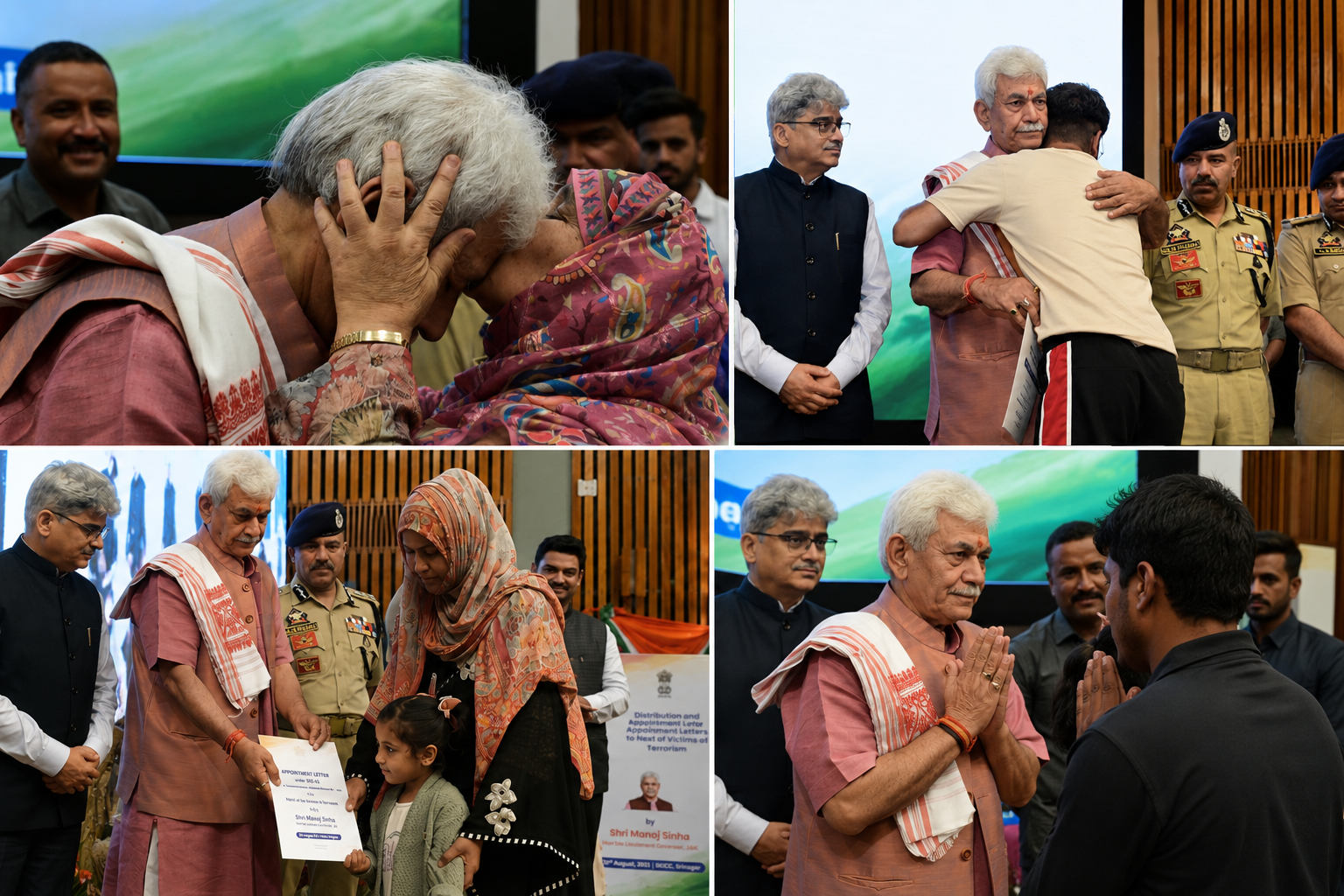
Kashmir, July 14,2026-History is often remembered through defining moments—days when long-standing aspirations are finally fulfilled, when the voices of those who have waited in silence are finally heard, and when justice reaches those who had almost given up hope. For the people of Jammu & Kashmir, 13 July 2025 will remain one such historic day.
On this day, under the leadership of Hon’ble Lieutenant Governor Shri Manoj Sinha, the Government of Jammu & Kashmir began the distribution of appointment letters to eligible members of terror victim families, starting from Baramulla. While the ceremony marked the beginning of an administrative process, its true significance extended far beyond government appointments. It represented the restoration of dignity, the recognition of decades of suffering, and the reaffirmation that the sacrifices made by innocent families in the face of terrorism would never be forgotten.
For more than three decades, terrorism cast a long shadow over Jammu & Kashmir. Thousands of innocent civilians became victims of violence. Families lost their loved ones—fathers, mothers, sons, daughters, brothers, and sisters—not because they had committed any crime, but because they found themselves caught in an era marked by fear and bloodshed. Along with the unbearable emotional trauma came financial hardship, social insecurity, and an uncertain future.
Many children who lost their parents at a young age grew up carrying responsibilities far beyond their years. Widows struggled to raise families with limited means. Elderly parents mourned the loss of their children while facing economic uncertainty. Countless families rebuilt their lives with extraordinary resilience, yet the pain of their loss remained a constant companion.
For many of these families, justice seemed distant. Years turned into decades. Some waited 33 years, others 35 years, and many 36 years before witnessing this moment of recognition. The passage of time could never erase their grief, but the beginning of this initiative sent a powerful message—that the sacrifices of innocent victims would not be forgotten and that the administration stood committed to acknowledging their suffering with compassion and responsibility.
The distribution of appointment letters therefore became much more than a government programme. Every appointment letter represented a family’s struggle, resilience, and hope. It symbolized not merely employment but the restoration of dignity. It acknowledged the sacrifices made by families who had endured unimaginable hardships while continuing to contribute positively to society despite overwhelming challenges.
The choice of Baramulla as the starting point carried deep significance. Baramulla has witnessed many chapters of Jammu & Kashmir’s complex history. Beginning this initiative there reflected a broader commitment to reaching every deserving terror victim family across the Union Territory and ensuring that justice was not confined to announcements but translated into meaningful action on the ground.
Behind every appointment letter lies a deeply personal story.
There are families who lost their sole breadwinner overnight. Children abandoned their education because survival became the immediate priority. Mothers spent decades ensuring their children received an education despite severe financial constraints. Young men and women grew up carrying memories of violence that shaped every aspect of their lives. Many of them continued believing that one day their sacrifices would be recognised.
For these families, receiving an appointment letter after more than three decades represented far more than the opportunity of employment. It reaffirmed that the State recognised their pain, valued their resilience, and stood beside them in their journey towards rebuilding their future.
Employment provides economic stability, but its significance in this context extends much deeper. A secure livelihood empowers families to educate their children, care for elderly parents, achieve financial independence, and rebuild lives interrupted by tragedy. More importantly, it restores confidence and self-respect, enabling individuals to move forward with renewed hope.
The initiative also carries an important social message. For many years, several terror victim families felt neglected or overlooked. Some even faced misunderstanding and unfair assumptions simply because they belonged to conflict-affected regions. Such experiences often deepened their emotional wounds.
The beginning of this process represents a conscious effort to restore not only livelihoods but also dignity. It acknowledges that these families stood on the side of peace despite enduring immense personal loss. Their resilience deserves recognition, respect, and support from society as a whole.
This initiative reflects an approach centred on compassion, inclusion, and justice. It recognises that governance is not merely about infrastructure, development projects, or economic indicators. True governance also involves standing beside those who have silently borne the greatest burdens and ensuring that they receive both recognition and opportunity.
The leadership shown in initiating this process underlines a commitment to addressing long-pending humanitarian concerns. Rather than allowing decades-old cases to remain forgotten, the administration chose to act, ensuring that deserving families finally witnessed tangible outcomes.
The process is equally significant because it is not presented as a one-time event. Beginning from Baramulla marked the first step in a continuing effort to identify and support eligible terror victim families across Jammu & Kashmir. This ongoing commitment reinforces confidence that justice is being approached systematically, transparently, and with long-term intent.
As someone associated with the Save Youth Save Future (SYSF) initiative, I feel deeply privileged to have witnessed and contributed, however modestly, to this historic journey. Being part of an initiative that seeks to build hope among families affected by decades of violence is both an honour and a profound responsibility.
Save Youth Save Future has consistently worked towards creating awareness, empowering communities, and encouraging positive social transformation. Supporting initiatives that strengthen justice, restore dignity, and build trust among citizens aligns with the broader vision of creating a peaceful and progressive Jammu & Kashmir.
The journey towards peace is never built through a single decision. It is shaped through countless acts of compassion, accountability, recognition, and justice. Every family that receives acknowledgement strengthens public confidence. Every deserving beneficiary who receives support demonstrates that the sacrifices of innocent citizens are neither forgotten nor ignored.
The significance of 13 July 2025 therefore extends beyond the distribution of appointment letters. It represents the beginning of healing for many families who have waited patiently for decades. It demonstrates that justice, although delayed, can still arrive with dignity. It reminds society that the true victims of terrorism deserve not only sympathy but meaningful opportunities that enable them to rebuild their lives.
This day also serves as an inspiration for future generations. Young people growing up in Jammu & Kashmir must understand the heavy cost that terrorism imposed on countless innocent families. Equally important, they should witness that society honours those who suffered while standing for peace, resilience, and humanity.
The stories behind these appointment letters are stories of courage. They are stories of mothers who never gave up, children who pursued education despite adversity, families who refused to surrender to despair, and communities that continued believing in a better future despite years of uncertainty.
Every appointment letter handed over is therefore a tribute to that courage.
It honours parents who sacrificed everything for their children. It recognises individuals who rebuilt their lives despite profound personal loss. It reassures families that their suffering has been acknowledged with respect and compassion.
No government decision can replace a loved one lost to terrorism. No appointment can erase decades of grief. Yet meaningful recognition can help families move forward with renewed confidence. It can restore hope where despair once existed and demonstrate that justice remains an enduring responsibility.
As this process continues across Jammu & Kashmir, it carries with it the aspirations of thousands of families who continue to believe in peace, justice, and a brighter future. Each step forward strengthens the collective resolve to ensure that innocent victims remain at the centre of the region’s journey towards lasting peace and inclusive development.
13 July 2025 will therefore always be remembered as more than a date on the calendar. It will stand as a milestone in the history of Jammu & Kashmir—a day when a long-awaited journey of justice truly began; a day when decades of silent suffering received overdue recognition; and a day when hope, dignity, and compassion found meaningful expression in the lives of terror victim families.
It is a reminder that while justice may sometimes take years to arrive, its value remains immeasurable when it finally reaches those who have waited the longest.