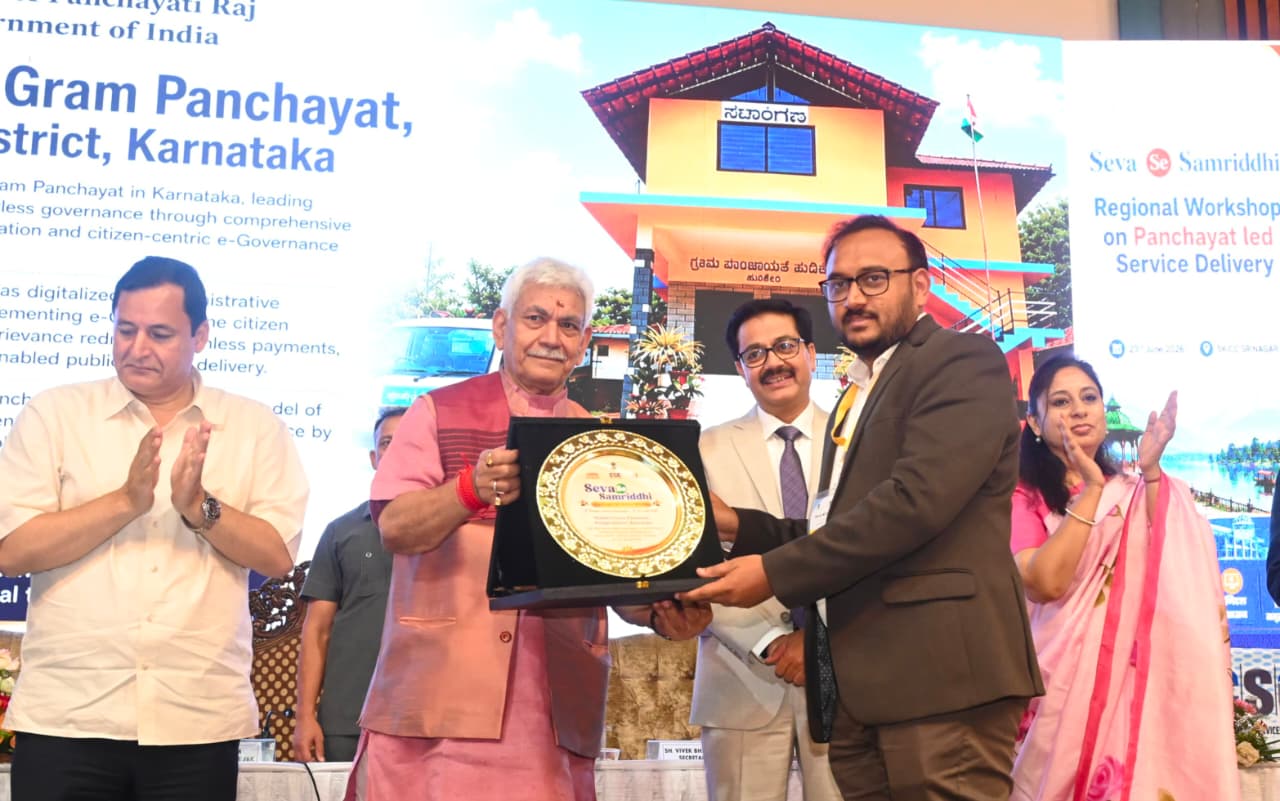
Srinagar, June 22,2026- Lieutenant Governor Manoj Sinha on Tuesday emphasized the transformative role of Panchayati Raj Institutions (PRIs) in strengthening grassroots democracy, improving governance, and accelerating India’s journey towards becoming a developed nation. Addressing a Regional Conference on Panchayati Raj in Srinagar, Sinha highlighted Jammu & Kashmir’s progress in local governance, digital empowerment, and citizen-centric administration while calling for greater collaboration and knowledge sharing among states.
The conference brought together representatives, officials, and Panchayati Raj stakeholders from several states, including Haryana, Jharkhand, Karnataka, Himachal Pradesh, Uttar Pradesh, and Uttarakhand. Welcoming the delegates, the Lieutenant Governor expressed gratitude to the Ministry of Panchayati Raj for choosing Srinagar as the venue for the important national-level event.
He said that hosting such a conference in Jammu & Kashmir reflects the region’s growing role in governance reforms and local self-government initiatives. He also acknowledged the support extended by officials of the Ministry of Panchayati Raj and thanked them for their continued cooperation in strengthening local governance mechanisms in the Union Territory.
Panchayati Raj at the heart of governance
During his address, Sinha described Panchayati Raj Institutions as one of the most important pillars of democratic governance. He noted that effective governance cannot be achieved without empowering local bodies and ensuring active participation of citizens in decision-making processes.
Reflecting on Jammu & Kashmir’s governance journey, he recalled that the Union Territory did not previously have a fully functional three-tier Panchayati Raj system. According to him, the implementation of the three-tier system marked a significant milestone in decentralizing governance and bringing decision-making closer to citizens.
He emphasized that the objective behind strengthening Panchayati Raj Institutions was clear from the beginning—to transfer funds, functions, and functionaries to local bodies so that development could be planned and implemented at the grassroots level. This decentralization, he said, enabled elected representatives and administrators to work together in identifying local priorities and delivering services more effectively.
Sinha explained that district-level development plans were prepared jointly by Panchayati Raj representatives and government officials. Such collaborative planning ensured that resources were directed towards projects that could deliver immediate and tangible benefits to citizens. While many of the projects were relatively small in scale, they played a crucial role in addressing local needs and improving quality of life in rural areas.
Transition from traditional administration to digital governance
A major portion of the Lieutenant Governor’s speech focused on Jammu & Kashmir’s transformation in governance through technology and digitalization.
Recalling his early days in the Union Territory, Sinha narrated an incident that illustrated the challenges of traditional administrative systems. He remembered visiting the Secretariat during the period when government offices shifted between Srinagar and Jammu. Hundreds of truckloads of files were being transported from one city to another as part of the annual Darbar Move process.
For him, the sight symbolized the limitations of a paper-based governance system in an era increasingly driven by technology. He pointed out that Jammu & Kashmir has since made remarkable progress by embracing digital governance and reducing dependence on physical documentation.
The Lieutenant Governor stated that the shift to online services has significantly enhanced efficiency, transparency, and accessibility in government functioning. Citizens today can access various government services digitally without the need to travel long distances or navigate complex bureaucratic procedures.
According to him, technology has become one of the most effective tools for delivering welfare benefits, public services, and citizen-centric governance. The expansion of digital infrastructure across Jammu & Kashmir has enabled government services to reach even remote areas, ensuring greater inclusivity and convenience.
Achievements in E-Service delivery
Highlighting the Union Territory’s achievements, Sinha noted that more than 1,100 government services became digitally accessible within a span of three years. This rapid expansion of e-governance initiatives significantly improved service delivery mechanisms and reduced administrative delays.
He proudly stated that Jammu & Kashmir emerged as a national leader in e-service delivery rankings, surpassing several larger states. Such achievements, he said, demonstrate how technology can transform governance when implemented effectively and with a citizen-first approach.
The Lieutenant Governor also highlighted initiatives such as Block Diwas, Thana Diwas, and Back to Village programmes. These initiatives were designed to bridge the gap between government institutions and citizens by creating direct channels for communication and grievance redressal.
According to him, these programmes have strengthened trust between the administration and the public while ensuring that citizens’ concerns are addressed promptly and effectively.
Digital transactions reflect changing citizen behaviour
One of the most striking statistics shared during the speech related to the growth of digital transactions in Jammu & Kashmir.
Sinha revealed that between 2016 and 2018, the region recorded approximately two crore digital transactions over a period of three years. In contrast, the first six months of 2023 alone witnessed nearly fifty crore digital transactions.
The dramatic increase, he said, highlights the rapid adoption of digital technologies by citizens and reflects growing confidence in digital platforms. He noted that the volume of digital transactions in Jammu & Kashmir exceeded that of several economically advanced states, demonstrating the success of digital empowerment initiatives.
The Lieutenant Governor attributed this growth to improvements in connectivity, digital literacy, and access to technology-enabled services. He described digital empowerment as an essential component of modern governance and a key driver of economic and social development.
Expanding digital connectivity across rural areas
Sinha further emphasized the importance of ensuring that digital infrastructure reaches every village and Panchayat.
He informed the gathering that more than 15,000 Common Service Centres (CSCs) are currently operational across Jammu & Kashmir. These centres serve as critical access points for government services, financial inclusion, and digital literacy programmes.
The Lieutenant Governor also shared that more than 98 percent of Panchayats in Jammu & Kashmir are connected through digital networks. Out of approximately 4,290 Panchayats, only a small number remain outside the network due to geographical and connectivity challenges in remote border regions.
He expressed confidence that these challenges would gradually be addressed through the Government of India’s Vibrant Villages Programme. The initiative focuses on improving connectivity and infrastructure in border areas through better telecommunications, roads, electricity, and satellite-based services.
According to Sinha, improving connectivity is essential not only for governance but also for economic development, education, healthcare, and social inclusion.
Learning from best practices across states
A key theme of the conference was the importance of knowledge sharing and collaborative learning among states.
The Lieutenant Governor urged delegates to exchange ideas, learn from successful models, and replicate innovative initiatives across different regions. He emphasized that governance challenges are often similar across states and that successful solutions developed in one area can benefit others as well.
Sinha suggested creating a structured national mechanism for sharing best practices among Panchayats and local bodies. Such a platform, he said, would allow innovative governance models to be documented, disseminated, and adapted across the country.
He argued that collaborative learning would strengthen Panchayati Raj Institutions and improve service delivery nationwide.
Recognizing innovation through National Awards
The Lieutenant Governor welcomed the introduction of a new category under the National e-Governance Awards 2025 aimed at recognizing grassroots innovations and excellence in service delivery by Gram Panchayats and traditional local bodies.
While appreciating the awards initiative, Sinha observed that recognition alone is not enough. He stressed the need to ensure that successful innovations are systematically shared and replicated across regions.
According to him, the true value of innovation lies not only in rewarding excellence but also in enabling others to learn from successful experiences and adopt proven solutions.
Village innovation labs: A vision for the future
One of the most forward-looking proposals in Sinha’s speech was the idea of establishing Village Innovation Labs within Panchayats.
He suggested that local innovation ecosystems could help identify community challenges and develop practical solutions at the grassroots level. Schools, colleges, local institutions, and Panchayats could work together to nurture creativity and encourage problem-solving.
The Lieutenant Governor emphasized that India should aspire to become a global hub of innovation and that this vision must extend beyond urban centres to villages and rural communities.
By fostering innovation at the grassroots level, he said, Panchayats can become engines of social and economic transformation.
Women’s leadership and social change
The Lieutenant Governor also highlighted the role of women in community development and social reform initiatives.
Speaking about anti-drug campaigns in Jammu & Kashmir, he praised the active participation of women-led groups and community organizations. According to him, women have played a decisive role in mobilizing communities, spreading awareness, and supporting efforts to combat substance abuse.
He noted that dozens of women-led committees are actively working on de-addiction and awareness programmes across the Union Territory, contributing significantly to social transformation.
Sinha stressed that sustainable development requires active participation from all sections of society and that women’s leadership is essential for building stronger and healthier communities.
Building the foundation for a developed India
Concluding his address, Lieutenant Governor Manoj Sinha reiterated that Panchayats must evolve into centres of innovation, transparency, accountability, and citizen empowerment.
He envisioned a future where citizens can access government services without unnecessary travel, where grievances are resolved efficiently, and where technology enables seamless interactions between people and institutions.
According to him, a developed Panchayat is far more than an administrative unit—it is a symbol of public trust, equal opportunity, innovation, and sustainable development.
The Lieutenant Governor expressed confidence that by empowering local institutions, embracing technology, and encouraging innovation, India can strengthen its democratic foundations and accelerate its journey towards becoming a developed nation.
As the conference concluded, his message remained clear: strong Panchayats are not only vital for effective governance but also essential for realizing the vision of a prosperous, inclusive, and self-reliant India.