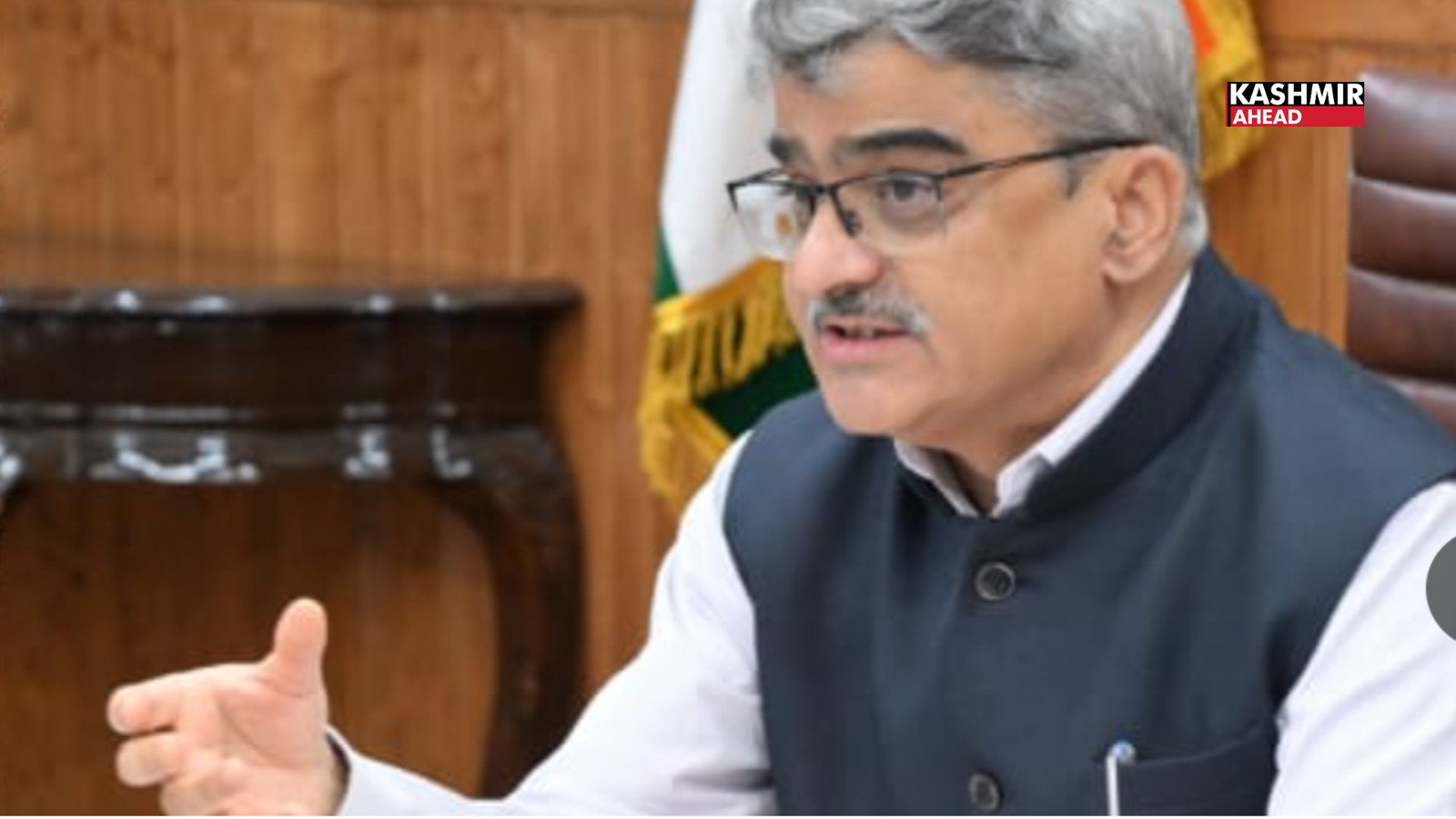
Srinagar, September 2 ,2026 – Chief Secretary Atal Dulloo on Tuesday reviewed the progress of the Jammu & Kashmir Infrastructure and Connectivity Development Programme, a sweeping portfolio of national highways, tunnels, flyovers, viaducts, bridges and ring roads being executed across the Union Territory by the Border Roads Organisation (BRO), National Highways Authority of India (NHAI), National Highways and Infrastructure Development Corporation Limited (NHIDCL) and the Public Works (R&B) Department.
The review also took stock of a large pipeline of projects at the DPR and in-principle stages, currently being prepared for sanction and inclusion in future work plans under various Government of India schemes.
The meeting was attended by senior officials including the Additional Chief Secretary of PWD, the Commissioner Secretary of Forests, Divisional Commissioners of Jammu and Kashmir, Deputy Commissioners, the Chief Engineer of Project Beacon/SAMPARK, PWD Chief Engineers, and regional officers of NHAI and NHIDCL.
Going through individual projects, Dulloo sought updates on physical progress and likely completion dates, underscoring the transformative importance of these connectivity works for the Union Territory. He directed divisional and district administrations to stay closely coordinated with executing agencies to clear bottlenecks and maintain the pace of construction, and asked that field-level issues be resolved proactively so approved timelines hold and the benefits reach people sooner.
He also asked agencies to keep existing road surfaces on under-construction highways safe and motorable for commuters, calling for urgent fixes to damaged stretches causing traffic snarls. He noted that the connectivity push would ultimately mean faster, safer movement of people and goods while boosting access to tourism and economically significant areas.
Additional Chief Secretary (PWD) Anil Kumar Singh opened the meeting with an overview of major projects under BRO, NHAI, NHIDCL and PWD, adding that agencies have identified further roads, tunnels and flyovers that could prove game-changing given the region’s difficult terrain.
The overall portfolio comprises 87 works valued at Rs 1,19,736 crore. Of these, 44 works worth Rs 39,711 crore are under execution, 11 sanctioned projects worth Rs 9,187 crore await commencement, and 32 projects worth Rs 70,839 crore remain at the DPR or in-principle stage.
Key NHAI projects reviewed included the Delhi-Amritsar-Katra Expressway (NE-5), the Ramban-Banihal tunnel packages, the Jammu Ring Road, Chenani-Patnitop connectivity and the Srinagar Ring Road. The five expressway packages span roughly 142 km at a cost of Rs 11,546 crore, with the Raya Morh-Samba-Kunjwani/Jammu Airport package over 96 percent complete and the Hiranagar package past 91 percent. The 78.8-km Srinagar Ring Road, spread across Phases I, II and IIA, carries a combined cost of Rs 4,786 crore and is progressing per revised schedules.
Project Beacon and SAMPARK works, aimed at improving all-weather connectivity to remote areas, were also discussed, along with the 141-km NH-501 Khanabal-Pahalgam-Chandanwari corridor (Rs 4,030.57 crore), whose alignment up to the Pahalgam bypass has been finalised, with environmental clearances still pending.
Among BRO’s 2025-26 tunnel sanctions are the Pir Ki Gali Tunnel on NH-701A and the Sadhna Tunnel, together worth about Rs 7,160 crore, while the Machil, Gurez and Keran tunnels are at the consultant-engagement stage under the OTCA budget.
NHIDCL projects reviewed included the Zojila and Khellani tunnels and the Jammu-Akhnoor packages, which have shown an average quarterly progress gain of 2.18 percent. PWD’s urban works included the Parimpora-Shalteng flyover, underpasses at Moominabad and Nowgam, and rehabilitation of the Padshahi Bagh and Lasjan bridges. NH-144’s Pir Panjal safety works, covering 55.05 km at Rs 18 crore, have been completed in full.
Dulloo directed agencies to fast-track DPR preparation, clearances and land requirements so pipeline projects can be sanctioned swiftly, and called for sustained coordination to ensure timely, safe and efficient delivery of the connectivity programme.