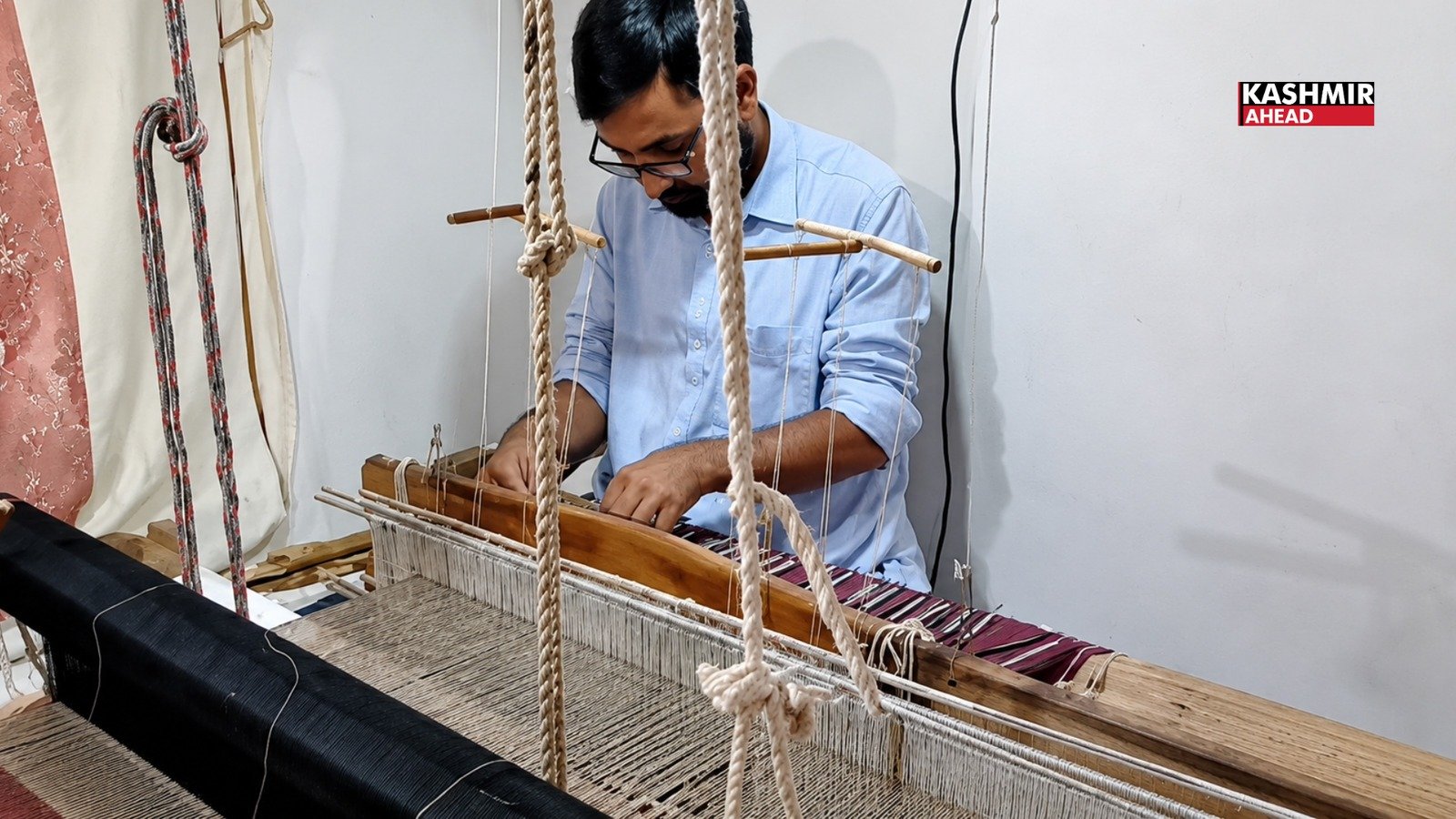
Srinagar, August 18,2026- National Handloom Award has brought national recognition to Kashmir’s centuries-old Kani weaving tradition, with Kanihama weavers Manzoor Ahmad Hajam and Fayaz Ahmad Wani receiving the prestigious honour for their Chand-Daar Kani Shawl.Manzoor Ahmad Hajam of Kanihama in Budgam district has been conferred the prestigious National Handloom Award, in a moment of quiet triumph for one of Kashmir’s oldest and most painstaking crafts. President Droupadi Murmu presented the National Handloom Award at a special function in New Delhi, held to mark National Handloom Day. Hajam received the honour jointly with fellow Kanihama weaver Fayaz Ahmad Wani, for their collaborative masterpiece, the Chand-Daar Kani Shawl.
The National Handloom Award, presented at the Rashtrapati Bhavan Cultural Centre during celebrations of the 12th National Handloom Day, carries with it a citation and a cash prize of ₹2.5 lakh — a modest sum, artisans say, against the years of labour such a shawl demands, but one that carries immense symbolic weight for a craft fighting to stay relevant in a mechanised world.
A Shawl Woven in Time
The Chand-Daar Kani Shawl is no ordinary textile. Kani weaving, native to the heritage village of Kanihama, is a technique in which artisans use small wooden spools called kanis — rather than a shuttle — to interlock coloured threads directly into the warp, building intricate, reversible floral and paisley motifs thread by painstaking thread. A single shawl of this complexity can take anywhere from six months to several years to complete, guided by coded pattern scripts known as talim that ensure exact precision across nearly twenty distinct hues.
It is, in essence, weaving as memory — a system passed down not through manuals but through apprenticeship and an eye trained over decades to read colour codes that look, to the untrained observer, like abstract poetry.
A Craftsman’s Quiet Legacy
Officials in Budgam noted that Hajam has spent close to 25 years associated with his teacher’s Kani weaving unit, embodying the Guru-Shishya tradition through which the craft has survived — often precariously — across generations. Local administration hailed the award as validation of an entire community’s stubborn commitment to keeping the loom threads moving.
The Handicrafts and Handloom Department, Kashmir, said the recognition places Kanihama’s weaving community “on the forefront of the crafts sector,” and could open new avenues for business and visibility for a craft that has often struggled against cheaper, machine-made imitations flooding the shawl trade.
Reacting to the news, Jammu and Kashmir Chief Minister Omar Abdullah congratulated both artisans, calling their achievement a celebration of “the timeless legacy and artistic excellence” of the region’s handloom tradition, and reaffirmed the government’s commitment to supporting indigenous crafts on national and global platforms.
Handlooms in the National Spotlight
Addressing the gathering in New Delhi, President Murmu spoke more broadly about India’s handloom economy, noting that the sector sustains roughly 35 lakh livelihoods, over 25 lakh of them women, and underlined the need to marry traditional craftsmanship with modern technology and digital marketplaces to help artisans reach wider, more lucrative audiences across the country.
For Kanihama — a village whose name is virtually synonymous with Kani weaving — the National Handloom Award is being read locally as more than a personal honour. It is a reminder, delivered from the national stage, that the slow, deliberate art practiced in its workshops still has a place in India’s cultural imagination, and perhaps in its economy too.
District authorities have used the moment to renew calls encouraging young people to take up Kani weaving and allied crafts as viable paths to livelihood and cultural preservation — a challenge as old as the craft itself, now given fresh urgency by a president’s citation and a shawl that took years to become one.
For a village that has watched younger generations drift toward easier, faster-paying trades, the National Handloom Award arrives as timely reassurance that mastery of a slow craft can still be seen, still be rewarded, and still matter on a stage as large as Rashtrapati Bhavan. Whether that recognition translates into new looms and new apprentices in Kanihama’s narrow lanes remains to be seen — but for now, the village has reason to celebrate a craft, and a family of craftsmen, finally getting their due.