Kashmir, August 17,2026- Homestays in Kashmir are giving travellers a new way to discover the Valley beyond the familiar postcards of Dal Lake, Gulmarg and Pahalgam.There is a Kashmir that travellers discover beyond the familiar postcards of Dal Lake, Gulmarg and Pahalgam. It is found in village courtyards, around a family kitchen, over a cup of noon chai, in conversations with an elderly host, and in the simple warmth with which a visitor is welcomed into a Kashmiri home.
That Kashmir is now becoming an important part of the Union Territory’s tourism story.
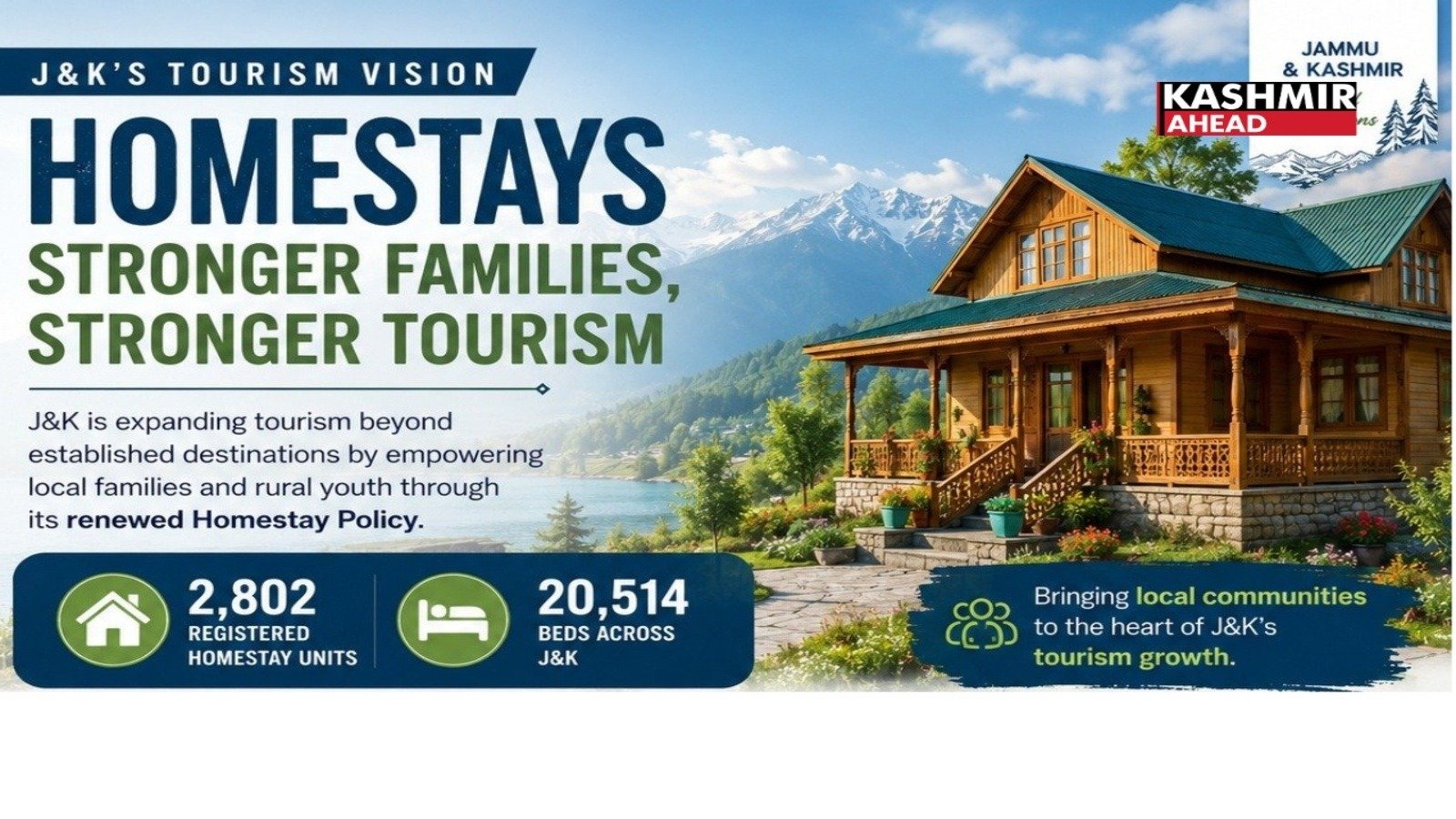
With the Jammu and Kashmir administration giving renewed emphasis to homestays, tourism is gradually moving beyond established destinations and opening new doors for rural communities. The renewed Homestay Policy is aimed at expanding accommodation in lesser-explored areas while making local families active participants in the tourism economy. According to the Tourism Department, J&K currently has 2,802 registered homestay units with a combined capacity of 20,514 beds.
But the real value of a homestay cannot be measured only in numbers.
A Home Can Become a Bridge Between Families
When a family from Maharashtra, Gujarat, Karnataka, Delhi, Rajasthan or any other part of India chooses to stay in a Kashmiri home, the journey becomes more than tourism.
It becomes an exchange.
The visiting family gets to experience Kashmir through the eyes of people who live here. They learn about local food, traditions, festivals, crafts, landscapes and everyday life. The Kashmiri host, in turn, gets to know another part of India through the stories, experiences and traditions of the visiting family.
A few days under the same roof can create a connection that a conventional hotel often cannot.
This is the quiet power of homestays: they allow people to meet people, not just destinations.
Kashmir’s Greatest Hospitality Is Its People
Hospitality has always been central to Kashmir’s social fabric. A guest is traditionally treated with warmth, respect and generosity.
Homestays give this quality of Kashmiri life a natural place within the modern tourism economy.
A visitor may wake up to the smell of traditional bread, share breakfast with a host family, hear stories about the village, visit a nearby orchard or handicraft workshop, and discover a landscape that may never have appeared on a conventional tourist itinerary.
These are experiences that cannot simply be manufactured.
They are lived.
And that makes them valuable.
Taking Tourism Beyond the Famous Destinations
For years, tourism in Kashmir has naturally concentrated around destinations that already have strong infrastructure and global recognition. The next opportunity is to spread the benefits of tourism more widely.
The administration’s renewed focus on homestays is designed precisely in this direction. Chief Secretary Atal Dulloo has described homestays as a key foundation for tourism in unexplored destinations and emphasised their potential to create employment and income opportunities while making local residents active stakeholders in tourism development.
This approach can bring more villages into Kashmir’s tourism map.
A family that once saw tourism only as something happening in distant tourist centres can become part of the experience itself.
A New Opportunity for Rural Families
The policy framework provides for residential properties where the owner and family live on the premises and offer between one and six guest rooms, subject to prescribed standards for safety, hygiene, water supply and electricity. It also introduces a Bed & Breakfast model that allows certain secondary residential properties to be used for tourist accommodation.
The renewed framework also focuses on simpler registration, training and capacity building, while financial institutions have been encouraged to support renovation and improvement of homestay facilities. The reported financing arrangement through J&K Bank can provide loans of up to ₹5 lakh per room, subject to a maximum of ₹30 lakh per homestay and applicable conditions.
For a rural household, this can mean something much bigger than an additional source of income.
It can mean an opportunity to invest in the family’s future without leaving the village.
It can encourage young people to see tourism, hospitality and entrepreneurship as viable careers close to home.
The Next Generation of Kashmir Tourism
For the younger generation of the Valley, the future of tourism should not simply mean more visitors at the same destinations.
It should mean more opportunities, more entrepreneurship and more reasons to believe in the future of their own communities.
Homestays can become a bridge between traditional life and a modern tourism economy. They can bring technology, digital bookings, better hospitality standards and new entrepreneurial skills into rural areas while allowing communities to preserve the character that makes them special.
The administration’s emphasis on training and handholding is therefore important. Quality hospitality requires not only a room, but also knowledge of guest management, hygiene, digital platforms, communication and sustainable practices.
Tourism With a Human Face
There is something deeply hopeful about a tourism model in which a traveller arrives as a guest and leaves having made friends.
That is perhaps the greatest promise of Kashmir’s homestay movement.
Every room opened by a Kashmiri family can become a small window into the Valley. Every family that visits can take home a story about Kashmir that goes beyond mountains and photographs.
And every meaningful interaction can quietly strengthen the idea that travel can bring people closer.
Kashmir does not need to reinvent its warmth. It only needs to create more opportunities for the world to experience it.
The renewed push for homestays can do exactly that — taking tourism deeper into Kashmir, taking opportunity closer to families, and bringing people from different parts of India closer to the people and culture of the Valley.
That is not merely a tourism strategy.
It is a hopeful vision of Kashmir’s future: where development creates opportunity, tourism creates understanding, and every home can become a bridge between people.