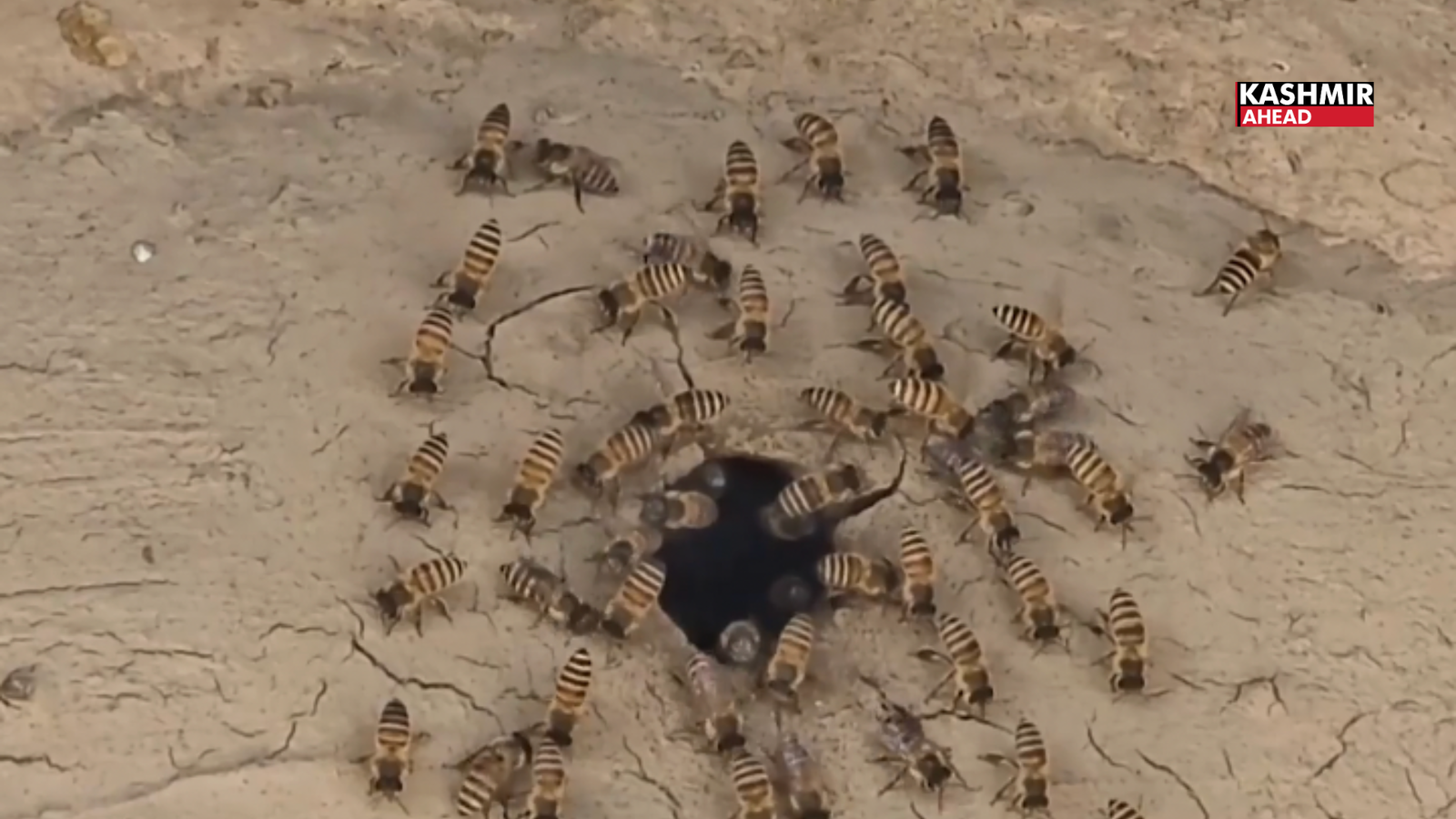
Doda, September 21,2026- In the picturesque village of Gajothe in Doda district, a father-son duo is keeping alive a centuries-old tradition that has been passed down through generations. 78-year-old Abdul Lateef Shiekh and his son, Qasim Ali, continue to practice wild beekeeping, carefully tending to honeybees found in the mountainous terrain surrounding their village, extracting pure, natural honey that has become both their livelihood and their legacy.
Unlike commercial beekeeping operations that rely on artificial hives and controlled environments, this traditional practice involves locating and nurturing wild bee colonies in their natural habitat among the flowers and forests of the region. The method requires deep knowledge of bee behaviour, seasonal patterns, and the local ecology — knowledge that has been carefully passed down within the family across three generations.
Speaking about the origins of this profession within his family, Qasim Ali said, “This profession has been passed down to us from our grandfather. Our grandfather did this work first, then our father continued it, and now I am involved in it. We are interested in taking this work forward because it is quite beneficial.” He emphasised the purity and authenticity of the product they produce, adding, “This is a natural product, made from flowers by the grace of Allah. We collect it ourselves and do not add anything or adulterate it. We collect the honey from flowers in the mountains.”
His remarks highlight a growing concern among consumers today regarding food purity, particularly honey, which is often adulterated in commercial markets. The Gajothe family’s insistence on maintaining an unadulterated, purely natural product sets their offering apart, relying entirely on the bees’ natural foraging from wildflowers across the mountains of Doda district.
Abdul Lateef Shiekh, the family patriarch who has been practising this craft for decades, spoke about his personal connection to the work despite his advanced age. “I am around 78 years old. I am still doing this work as a hobby and as a business. I take an interest in it, and it is also my passion. Apart from that, there is nothing else,” he said. His words reflect not just an economic necessity but a genuine passion for a craft that has defined his life’s work.
Notably, Abdul Lateef Shiekh revealed that the family has pursued this traditional occupation entirely independently, without any external support. “We have never approached the government for any assistance in this work; we are doing it on our own. Whatever we get depends on the season,” he said. This self-reliance underscores the resilience of rural artisans in Jammu and Kashmir, who continue age-old practices despite the absence of institutional backing or formal recognition.
The seasonal nature of wild beekeeping, as noted by Shiekh, means that yields can vary considerably from year to year, depending on weather conditions, flowering patterns, and the health of wild bee populations in the region. Despite these uncertainties, the family has continued to rely on this practice as a sustainable source of income, supplementing it with the personal satisfaction that comes from continuing a family tradition.
Gajothe village, nestled in the hills of Doda district, offers an ideal environment for such traditional beekeeping due to its rich biodiversity and abundance of wildflowers during the appropriate seasons. The region’s rural knowledge systems, often overlooked in favour of modern agricultural and commercial practices, continue to sustain families like that of Abdul Lateef Shiekh and Qasim Ali.
As younger generations across rural Jammu and Kashmir increasingly migrate towards urban employment and modern occupations, the continuation of this practice by Qasim Ali represents a rare and valuable commitment to preserving indigenous knowledge. The story of this father-son duo from Gajothe stands as a testament to the enduring value of traditional livelihoods, rural wisdom, and the deep connection between local communities and their natural environment.