Srinagar, September 6, 2026-In a government classroom in Soura, a suburb of Srinagar, empty bottles, torn cardboard, and discarded candy wrappers don’t go in the bin. They go into a lesson plan.
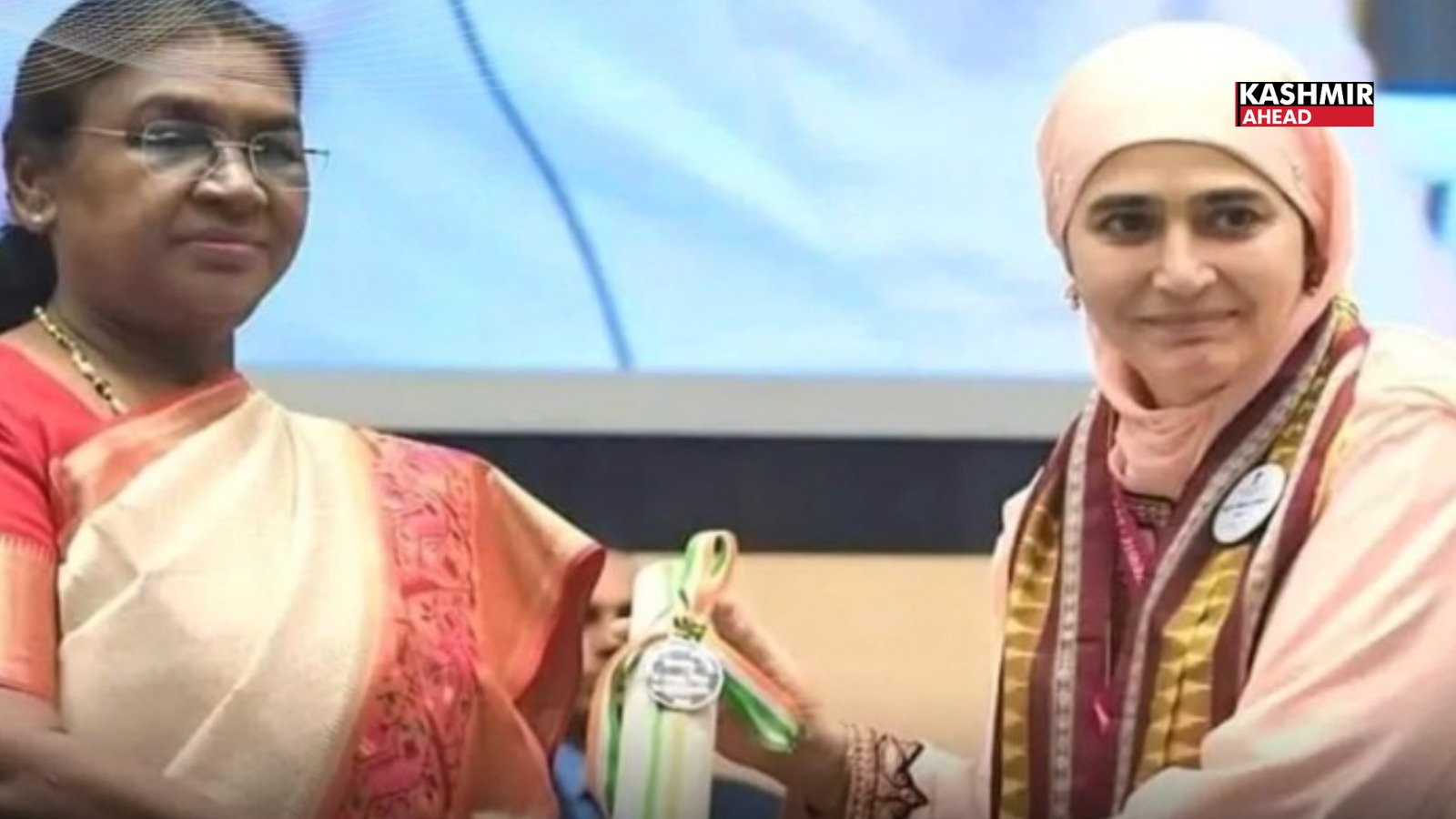
That is the trademark of Dr Urfana Amin, a Master Grade Teacher at Government Boys Higher Secondary School Soura, whose unconventional, resourceful, and deeply inclusive teaching methods have earned her one of India’s highest honours for educators, the National Teachers’ Award, presented by President Droupadi Murmu.
Amin was among 50 teachers selected nationwide for the 2024 award, chosen from a pool of 154 shortlisted candidates after a rigorous evaluation process. Hailing from the Lal Bazar area of Srinagar, she was recognised for a portfolio of contributions that includes developing the Foundational Literacy and Numeracy (FLN) module, producing e-content for the government’s DIKSHA learning portal, and advancing adult literacy programmes across Jammu and Kashmir.
At the heart of her recognition, though, is a simple, homegrown philosophy she calls “Learn Big from Small.” The idea is to take the humblest, most overlooked objects — a plastic bottle, a strip of cardboard, a candy wrapper — and turn them into hands-on tools for teaching mathematics, science, and everyday concepts. Rather than having students memorise facts from a textbook, Amin’s classrooms push children to build, tinker, and discover principles for themselves, turning them from passive listeners into makers, explorers, and problem-solvers.
“Her approach transforms students from passive learners into makers, explorers and problem-solvers by encouraging them to create their own learning materials,” is how the philosophy has been described, and it reflects an approach Amin has spent nearly two decades refining. As far back as 2007-08, she developed a curriculum for Jammu and Kashmir that was formally adopted by the State Institute of Education (SIE).
But it is Amin’s work on inclusive education that stands out as her most distinctive contribution. She holds specialised training in Inclusive Education from Bhoj University in Madhya Pradesh, in addition to a Master’s in Education and Early Childhood Care and Education from NCERT. That training translates directly into her classroom: Amin has developed proficiency in Braille and uses it to support Children with Special Needs (CWSN), ensuring that students with visual impairments and other learning differences are not left on the margins of the classroom but are active participants in it.
Colleagues and officials have pointed to this work — bridging the gap for children with differing abilities and learning needs — as pivotal to her national recognition. Her efforts as a National Resource Person and her role with the All Jammu and Kashmir Modern Educational Resources (AJMER) group have extended her influence well beyond her own classroom, feeding into teacher training programmes across the Union Territory.
Amin’s résumé is unusually layered for a school teacher: she holds a doctorate in Human Resource Management, a Master’s in English and Management Studies, and has authored educational books that have been folded into official department training material in Jammu and Kashmir. She has also won the Global Education Teacher Award in both 2020 and 2021, and received gold medals for science teaching at the primary level from the National Science Council of Teacher Scientists in 2022.
Speaking after her selection, Amin credited the people around her for pushing her forward. “The encouragement from my friends and colleagues pushed me to apply for this award,” she said, adding that her family’s support — particularly her husband’s — had been “a pillar of strength” throughout her career.
The National Teachers’ Award, conferred each year on Teachers’ Day, carries a silver medal, a cash prize of Rs 50,000, and a certificate of merit. For Amin, it is also a validation of a simple conviction: that big lessons often come from the smallest, most ordinary things.