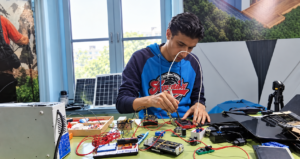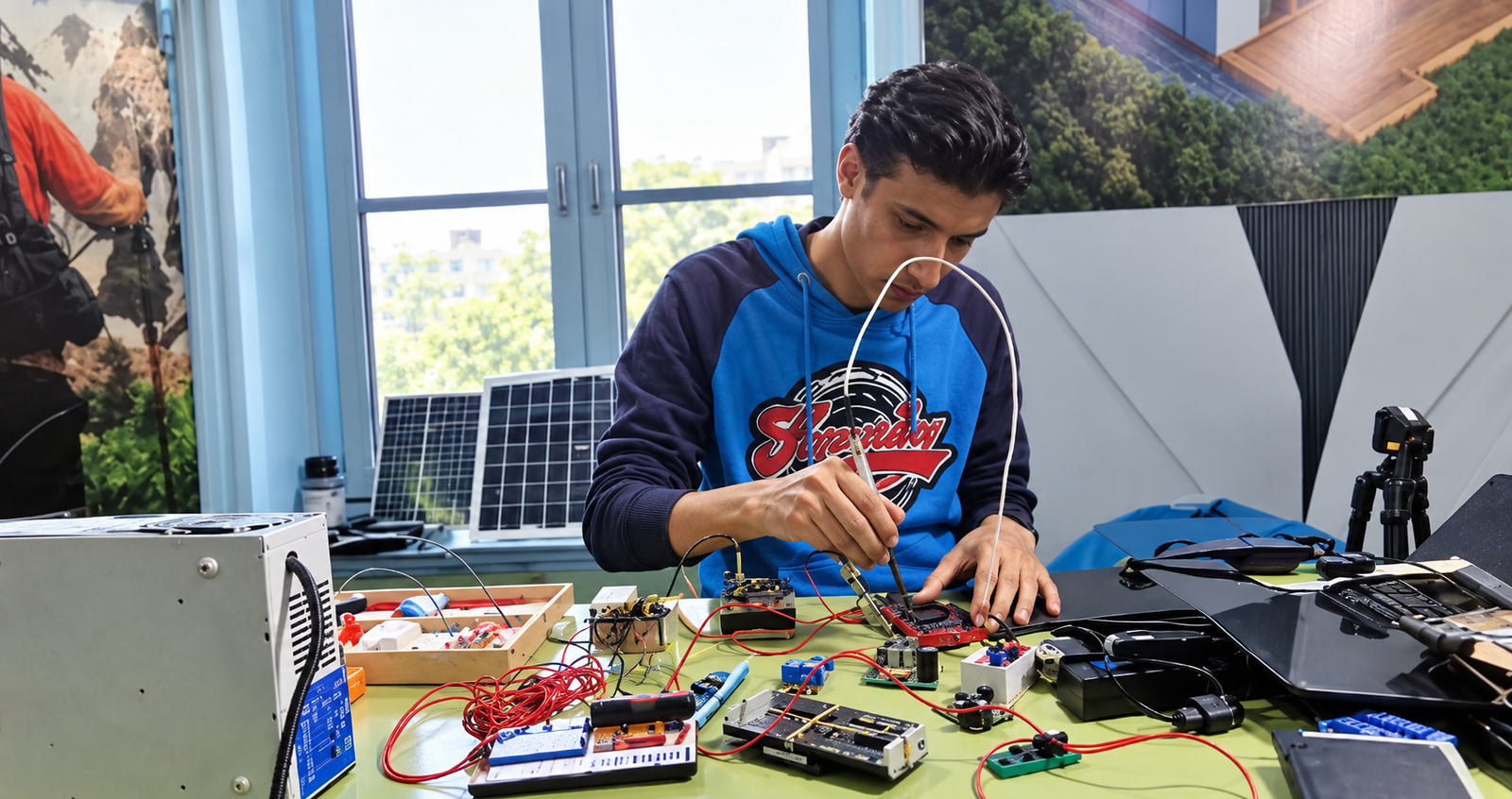
Srinagar, October 27,2026- In a world increasingly focused on clean energy, sustainable mobility and technological innovation, a mathematics teacher from Kashmir is demonstrating how curiosity and practical skills can turn ideas into reality. Meer Bilal, who has reportedly spent the last 15 years experimenting with innovative technologies, has developed solar-powered vehicles, including a car named ‘RAY’ and a solar-powered scooty.
Bilal’s journey highlights the potential of local innovators in Jammu and Kashmir and raises an important question: can the region create an environment where homegrown ideas develop into globally recognised technological innovations?
Often compared with prominent innovators such as Elon Musk because of his interest in futuristic transportation, Bilal represents a different but equally interesting story. His work reflects the possibilities that emerge when individuals look beyond conventional learning and begin experimenting with practical solutions to everyday challenges.
RAY: Exploring the Potential of Solar-Powered Mobility
Among Bilal’s reported innovations is RAY, a solar-powered car that showcases his interest in alternative energy and transportation. His work on a solar scooty further reflects an effort to explore how renewable energy can be applied to personal mobility.
As concerns over fossil-fuel consumption, pollution and energy security grow, solar-powered transportation has attracted attention worldwide. Although the practical performance of such vehicles depends on factors such as solar-panel efficiency, battery capacity, motor specifications and operating conditions, small-scale experiments can help innovators understand the possibilities and limitations of renewable-energy technologies.
For Bilal, these projects represent more than mechanical experiments. They reflect a belief that technological development should not remain confined to laboratories, universities or large companies. With the right knowledge, tools and opportunities, individuals can also participate in the process of innovation.
Bilal is also reported to have several patents associated with his innovations. Details about the patents, their registration status and the technical specifications of his projects would help establish the full extent of his work and its potential for wider application.
Fifteen Years of Experimentation and a New Vision
Innovation rarely happens overnight. It often requires years of experimentation, repeated failures, technical adjustments and the willingness to challenge established methods.
Bilal’s reported 15-year journey illustrates the importance of sustained curiosity and hands-on learning. His work also draws attention to the opportunities available to people who combine academic knowledge with practical problem-solving.
His next proposed experiment is a boat designed to operate using natural resources. The concept points towards his continuing interest in alternative energy and sustainable transportation. Further technical details would be needed to determine the proposed boat’s energy source, operating mechanism and environmental benefits.
Nevertheless, the idea reflects a broader question facing aspiring innovators in Jammu and Kashmir: how can individual experiments become the foundation for research, entrepreneurship and commercially viable technologies?
Why Skill-Based Education Matters
Bilal’s journey also brings the discussion around education into focus. Traditional classroom learning provides essential foundations, but students also need opportunities to apply what they learn through experiments, projects, workshops and real-world problem-solving.
India’s National Education Policy (NEP) 2020 places emphasis on experiential learning, critical thinking, vocational education and the development of practical skills. Its approach encourages a move away from rote memorisation towards learning that helps students understand concepts and apply their knowledge.
For students in Jammu and Kashmir, this approach could open new pathways in fields such as renewable energy, robotics, electronics, automobile engineering and product design.
Schools and colleges can support this transition by establishing innovation laboratories, organising science exhibitions, encouraging student-led projects and connecting young people with mentors from technical and industrial backgrounds.
Access to affordable equipment, specialised training and funding can also make a difference, particularly for students and innovators working outside established research institutions.
Can Kashmir Build Its Own Innovation Ecosystem?
Individual ingenuity is an important starting point, but building a sustainable innovation ecosystem requires more than the efforts of one person.
Technical institutions, universities, government departments, private companies and investors can help promising ideas move from prototypes to tested products. Patent assistance, engineering mentorship, product testing facilities and startup incubation programmes can provide innovators with the support needed to refine their work.
For Jammu and Kashmir, promoting innovation could also create opportunities for young people to develop solutions suited to local needs, including renewable energy, agriculture, tourism, transportation and environmental protection.
At the same time, the success of any invention depends on measurable performance, safety, affordability and the ability to operate reliably under real-world conditions. Independent technical evaluation and transparent documentation would help determine how Bilal’s projects could be improved, scaled or adapted for wider use.
Beyond Comparisons, a Call for Innovation
The comparison with Elon Musk makes for an attention-grabbing headline, but Bilal’s story ultimately raises a more important issue: how can Jammu and Kashmir provide more people with the opportunity to experiment, invent and build?
His solar-powered car, scooty and proposed natural-resource-powered boat represent an ambition to explore alternatives through practical innovation. With appropriate technical support, verification and access to resources, such efforts can become valuable learning opportunities for aspiring inventors.
The challenge now is to ensure that curiosity receives the support it needs to grow into expertise, and that promising ideas are given a fair opportunity to prove their value.
Is Kashmir ready for an innovation revolution? The answer may depend on whether the region can turn individual determination into a broader culture of experimentation, skill development and technological entrepreneurship.