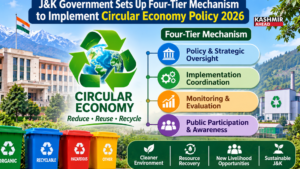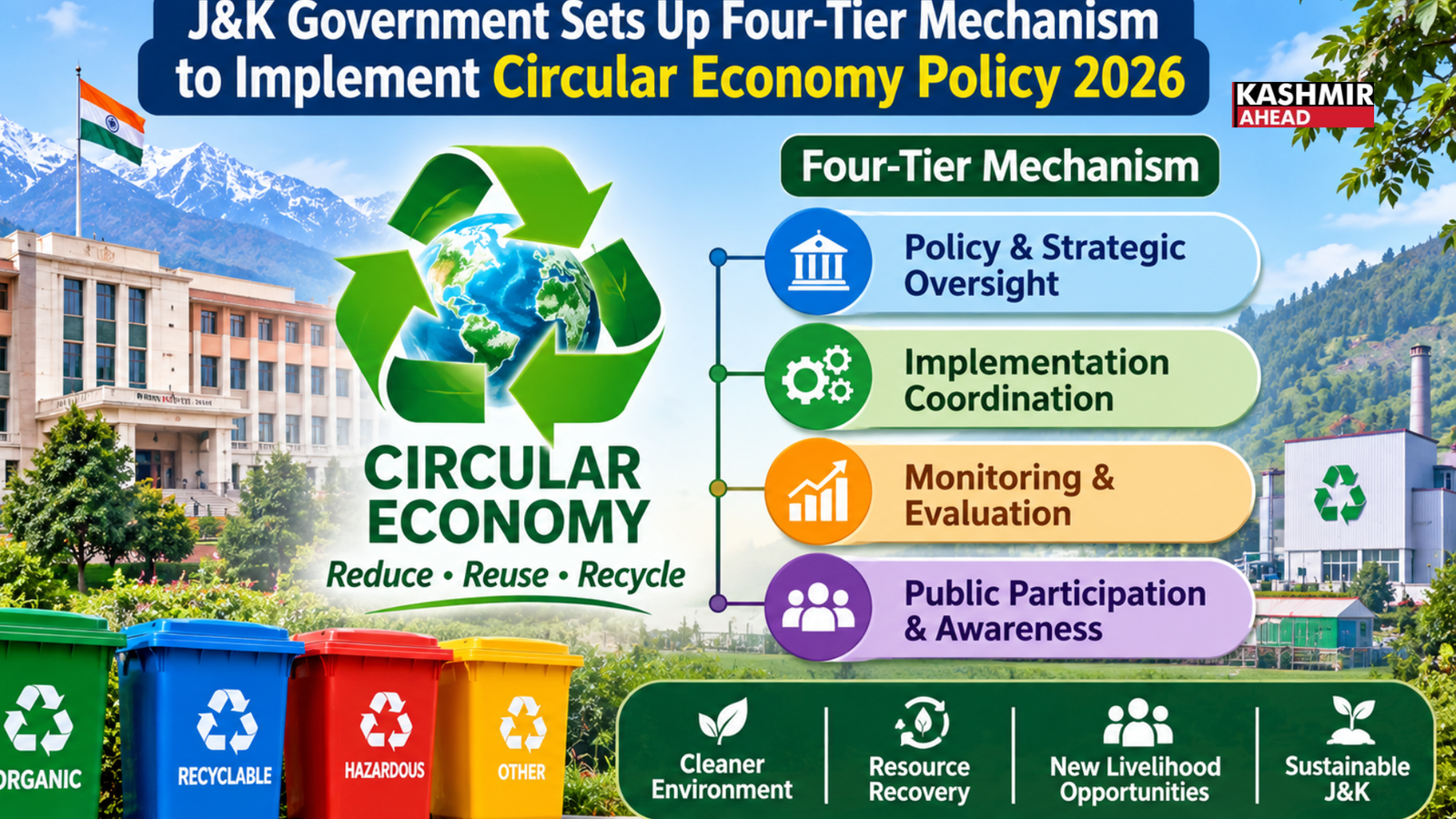
Srinagar, November 1,2026-The Jammu and Kashmir Government has established a four-tier institutional mechanism to ensure the effective implementation of the Circular Economy Policy 2026, marking an important step towards strengthening waste management, promoting resource recovery and creating sustainable livelihood opportunities across the Union Territory.
The initiative aims to transform the existing approach towards waste management by encouraging the reuse, recycling and recovery of valuable resources from waste. Through the new mechanism, the government intends to promote a circular economic model in which waste is treated as a resource rather than simply something to be discarded.
The Circular Economy Policy 2026 is expected to provide a structured framework for improving waste management practices, reducing environmental pollution and encouraging the efficient use of natural resources. It also seeks to strengthen coordination among government departments, local authorities, industries and other stakeholders involved in waste management and resource utilisation.
The establishment of a four-tier mechanism is expected to ensure better institutional coordination, regular monitoring and accountability during the implementation of the policy. The multi-level structure will help translate policy objectives into practical action while addressing implementation-related challenges at different administrative levels.
A key focus of the initiative is to strengthen waste segregation, collection, transportation, processing and recycling systems. Improved waste management practices can help reduce the pressure on landfills, prevent environmental degradation and ensure that recyclable materials are recovered and reused productively.
The policy also places importance on resource recovery, which involves extracting useful materials from different categories of waste and returning them to the production cycle. This approach can reduce dependence on fresh raw materials, improve resource efficiency and support environmentally responsible economic activities.
For Jammu and Kashmir, the initiative carries significance in view of its fragile ecological environment, growing urbanisation and increasing pressure on natural resources. Effective waste management is particularly important for protecting water bodies, forests, agricultural land and the region’s scenic surroundings.
The government is also looking at the economic opportunities associated with the circular economy. Recycling, waste processing, material recovery and other related activities have the potential to generate employment and encourage entrepreneurship, particularly among young people, women and local communities.
By promoting waste-based enterprises and encouraging private sector participation, the policy can help create new income-generating opportunities while supporting sustainable development. Local entrepreneurs and small businesses may find opportunities in recycling units, compost production, waste collection services and the processing of reusable materials.
Another important aspect of the initiative is the need to encourage public participation. The success of any waste management framework depends significantly on responsible disposal practices, household-level waste segregation and awareness among citizens. Greater cooperation between communities, urban local bodies and rural institutions can help improve the overall effectiveness of the system.
The four-tier institutional arrangement is expected to provide the necessary administrative support to ensure that the policy is implemented in a coordinated and result-oriented manner. Regular monitoring and interdepartmental cooperation will be important in assessing progress and ensuring that the objectives of the policy are achieved.
The move reflects Jammu and Kashmir’s broader commitment to sustainable development, environmental protection and responsible resource utilisation. By integrating environmental priorities with economic opportunities, the Circular Economy Policy 2026 seeks to establish a system that benefits both the environment and local communities.
With the establishment of the four-tier mechanism, the government has taken an important step towards building a more sustainable and resource-efficient economy in Jammu and Kashmir, where effective waste management can contribute to environmental conservation, employment generation and long-term economic growth.