Kashmir, September 20,2026-The vision and sustained efforts of Prime Minister Narendra Modi over the past decade have culminated in the completion of the 272-km Udhampur-Baramulla-Srinagar Railway Link (USBRL), finally connecting Kashmir with the rest of the country by rail. What was once considered one of the most challenging railway projects ever undertaken in independent India has now become a reality, transforming connectivity, commerce, and everyday life across the Kashmir Valley.
First declared a “National Project” in 2002, the USBRL was constructed in phases due to the extraordinarily difficult Himalayan terrain it traverses. The Qazigund-Baramulla section was commissioned in 2009, followed by the Banihal-Qazigund stretch in 2013 and the Udhampur-Katra section in 2014. The most formidable segment, however, remained the 111-km Katra-Banihal stretch, where nearly 87 percent of the route passes through tunnels, including the country’s longest transportation tunnel, T-49, stretching 12.75 km.
In total, the USBRL involved the construction of 38 tunnels spanning a combined length of 119 km and 927 bridges covering 13 km. This staggering scale of engineering, carried out amid complex geology and extreme weather conditions, is what makes the project’s completion such a remarkable achievement.
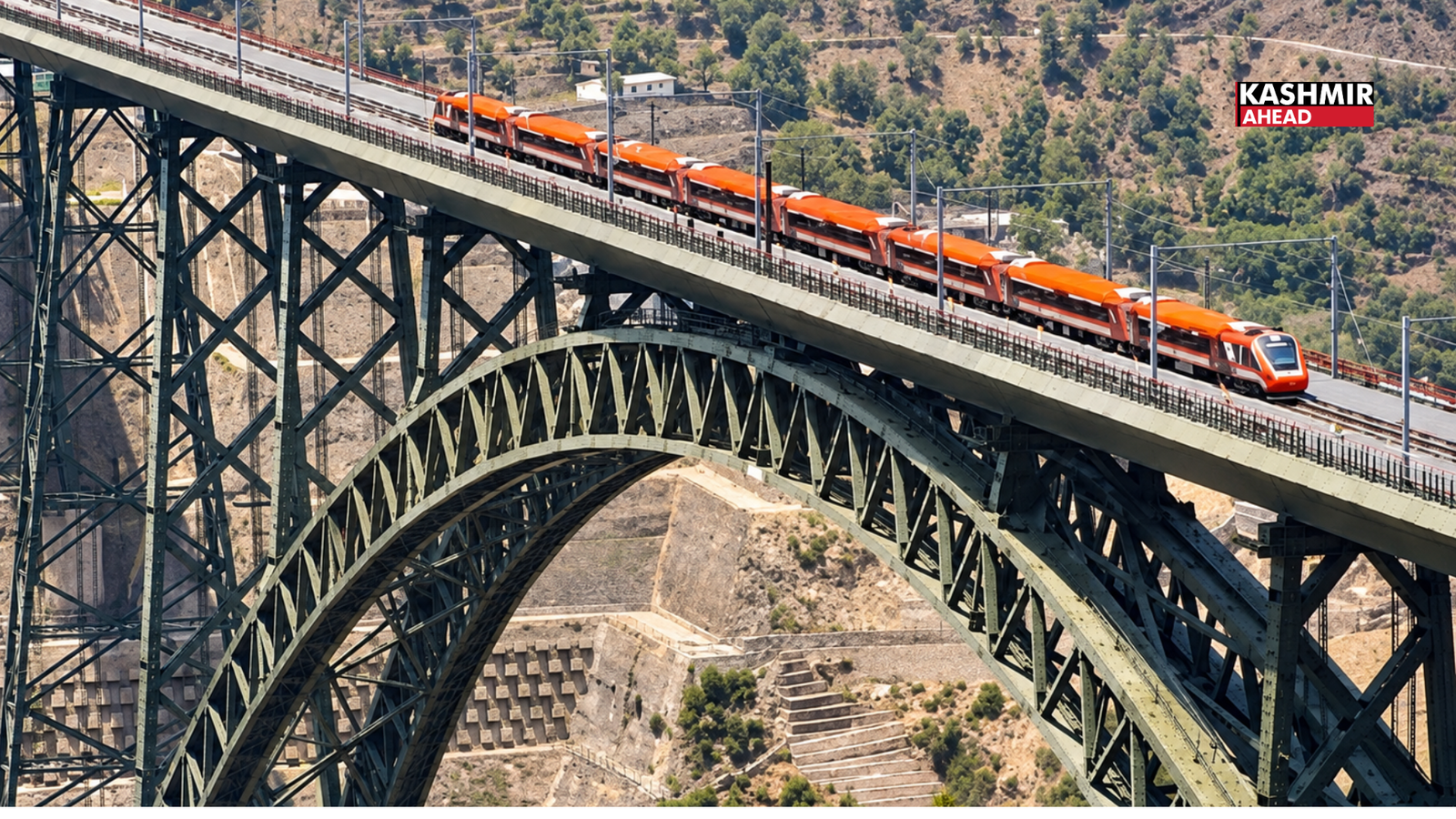
At the heart of this monumental undertaking stands the Chenab Bridge, widely regarded as an architectural marvel and now recognized as the world’s highest railway bridge. Spanning the Chenab River with an arch span of 467 meters and rising 359 meters above the riverbed, the bridge is taller than the Eiffel Tower and stands as a testament to India’s engineering capability. Its construction required specialized techniques to withstand high wind speeds, seismic activity, and the region’s rugged mountainous terrain — challenges that had stalled progress for years before being successfully overcome.
Alongside the Chenab Bridge, the project also delivered India’s first cable-stayed railway bridge over the Anji Khad, an asymmetrical structure balanced on a central pylon with a total length of 725.5 meters, further showcasing the technical sophistication brought to this Himalayan railway corridor.
Beyond the engineering feat, the completion of the USBRL carries deep strategic and socio-economic significance. For decades, Kashmir’s connectivity to the rest of India relied heavily on road transport, which remained vulnerable to weather disruptions, landslides, and seasonal closures. The all-weather rail link now offers a reliable, faster, and safer alternative, expected to boost tourism, trade, and everyday mobility for residents of the Valley.
The project’s progress was personally monitored by Prime Minister Modi and the Ministry of Railways over the years, reflecting the government’s consistent focus on integrating Jammu and Kashmir more closely with national infrastructure networks. Officials have described the USBRL as one of the most complex railway undertakings in the country’s post-independence history, given the geological unpredictability of the Himalayan region through which it passes.
With the rail line now fully operational, Kashmir stands connected to the Indian railway network for the first time in history — a development that many view as a turning point not just for transportation, but for the region’s broader economic and social integration. The Chenab Bridge, in particular, has already become a symbol of national pride, drawing attention for its scale and ambition as one of the most extraordinary infrastructure achievements in recent Indian history.
As trains now traverse this once-unthinkable route through the mountains, the USBRL stands as a lasting testament to a decade of sustained commitment, engineering excellence, and the vision of bridging Kashmir with the rest of the nation.