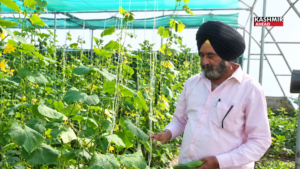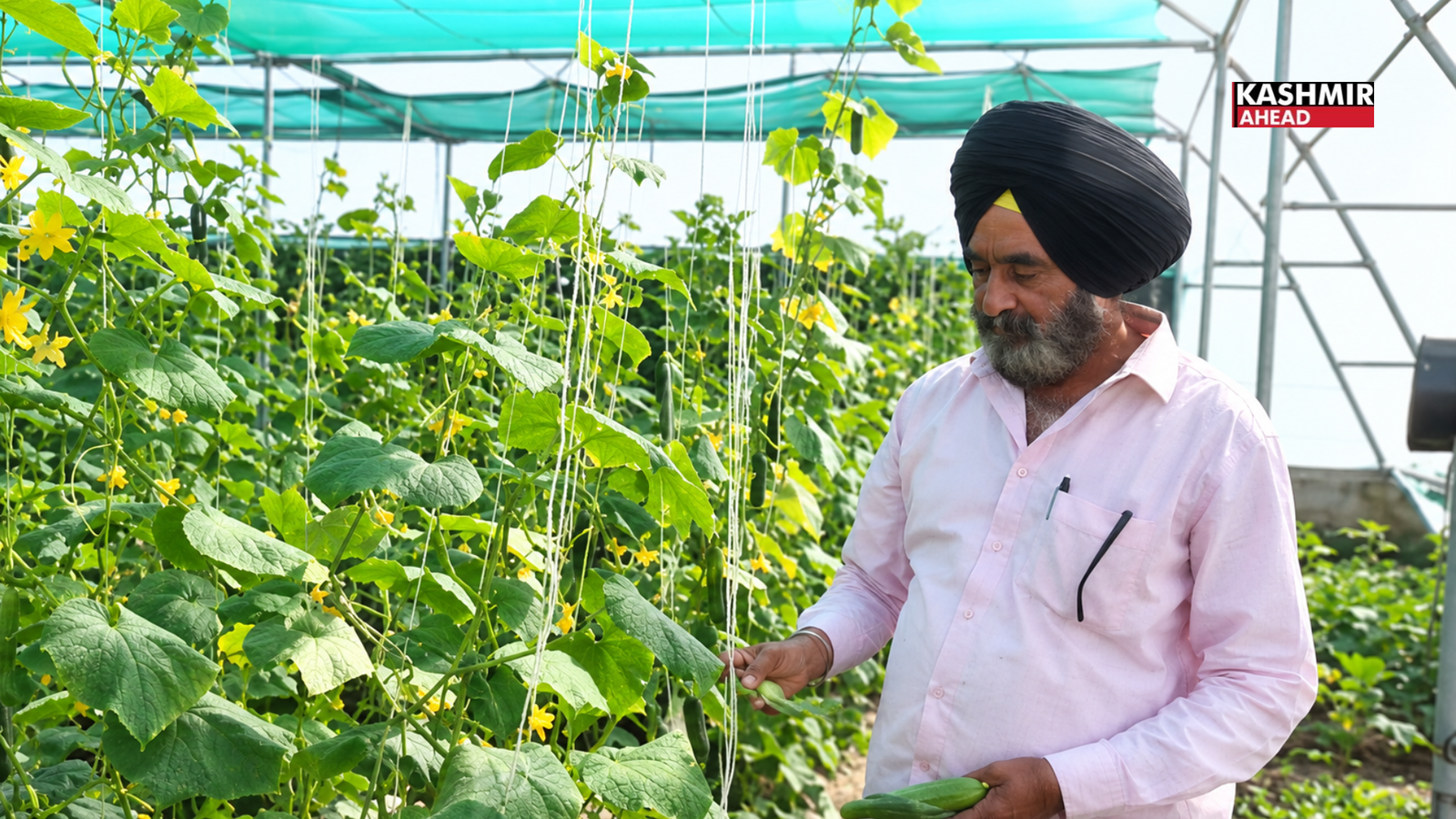
Jammu, October 28,2026- A 62-year-old progressive farmer from Jammu’s border village of Ranjitpur is demonstrating how modern agricultural practices and protected cultivation can help farmers improve their income. Gurnam Singh, a resident of Ranjitpur village in Marh block, has adopted polyhouse farming to cultivate premium seedless cucumbers, a high-value crop that offers better market returns than conventional varieties.
By moving beyond traditional farming methods, Singh has tapped into the growing demand for seedless cucumbers, which are valued for their quality and suitability for fresh consumption. According to the information shared, his produce fetches nearly four times the price of regular cucumbers, providing him with an opportunity to earn higher returns from his agricultural activities.
Singh’s polyhouse was established with support from the Agriculture Department under the Holistic Agriculture Development Programme (HADP). The project involved a total investment of ₹17.29 lakh, of which ₹16.25 lakh was provided as a subsidy by the department.
The substantial subsidy support helped facilitate the establishment of the protected cultivation unit, enabling the farmer to adopt a modern farming technique designed to support the cultivation of high-value crops. Polyhouse farming allows growers to cultivate crops in a controlled or partially controlled environment, helping manage growing conditions and improve crop quality.
The initiative highlights the potential of protected cultivation in diversifying agricultural activities and creating additional income opportunities for farmers, particularly those in border areas. By selecting crops according to market demand, farmers can explore alternatives to conventional cultivation and potentially improve the economic viability of their farms.
Gurnam Singh’s experience also underscores the importance of agricultural schemes that provide financial assistance and encourage farmers to adopt innovative techniques. Government support for polyhouses and high-value crop cultivation can help reduce the initial investment burden and make modern agricultural infrastructure more accessible to farming communities.
For farmers in Jammu and Kashmir, the adoption of seedless cucumber cultivation offers an example of how crop diversification, market-oriented production and protected farming can contribute to improved farm incomes.
Singh’s initiative in Ranjitpur serves as an example for other farmers interested in exploring modern agricultural practices. His experience highlights the scope for expanding protected cultivation and high-value vegetable production in Jammu, while emphasising the role of departmental assistance in supporting agricultural innovation and rural livelihoods.