Kishtwar, October 14,2026- Kishtwar district has secured the first rank among 100 districts nationwide for strengthening irrigation infrastructure under the PM Dhan-Dhaanya Krishi Yojana. Union Agriculture Minister Shivraj Singh Chouhan presented the Certificate of Excellence to ADM Pawan Kotwal and Chief Agriculture Officer (CAO) Kushal Chandel in New Delhi. The recognition acknowledges the district’s efforts to expand irrigation, revive water resources, and promote sustainable agriculture.
A National Recognition for a Hill District
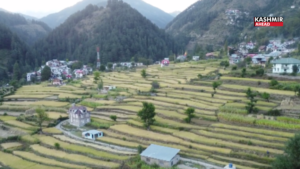
Topping a national ranking of 100 districts is a notable achievement for Kishtwar, a mountainous district where farming depends heavily on natural water sources and where terrain makes irrigation work difficult. The Certificate of Excellence reflects sustained effort by the district administration and the agriculture department.
The presentation by the Union Agriculture Minister in New Delhi gave the achievement national visibility. It also recognised the officers who led the work on the ground, ADM Pawan Kotwal and CAO Kushal Chandel.
Why Irrigation Matters
In hilly regions, many farms rely on rainfall and seasonal streams. When rains are erratic or springs weaken, crops suffer and incomes become uncertain. Reliable irrigation changes this in several ways:
- It protects crops during dry spells.
- It allows farmers to grow more than one crop in a year.
- It supports higher-value crops such as vegetables and fruits.
- It improves yields and stabilises household incomes.
For small and marginal farmers, who make up much of the farming community in the region, dependable water can be the difference between subsistence and a steady livelihood.
Reviving Water Resources
The recognition specifically cites efforts to revive water resources. In mountain areas, traditional water sources such as springs, streams, and channels often decline because of silting, neglect, or changing weather patterns. Restoring and maintaining them is among the most cost-effective ways to improve water availability.
Reviving such sources also supports the wider environment. Healthy springs and streams sustain village water supply, grazing lands, and local ecosystems, so benefits extend beyond the farm.
Sustainable Agriculture as the Goal
Expanding irrigation is not only about delivering more water. It is also about using water wisely. Sustainable agriculture means making the best use of limited resources while protecting land and water for the future. Efficient practices, community-managed water systems, and proper upkeep of structures help ensure that gains last beyond a single season.
The ranking suggests that Kishtwar has made progress on this front, combining the expansion of irrigation with the revival of existing water sources.
The Role of Convergence and Teamwork
Results of this kind rarely come from a single department. Irrigation, agriculture, rural development, and local bodies often have to work together, and farmers must be part of the effort. The recognition of the ADM and the CAO points to the importance of coordination between district administration and technical departments.
Such coordination matters in a district like Kishtwar, where scattered settlements and difficult terrain make planning and delivery more demanding.
What It Means for Farmers
For farmers, a top national ranking is welcome, but the real test is whether benefits reach the field. Better irrigation facilities can mean more reliable harvests, lower risk, and the confidence to invest in better seeds and crops. Over time, this can strengthen rural incomes and reduce distress migration from villages.
The achievement also sets a benchmark. Other districts in Jammu and Kashmir can learn from the approach and adapt it to their own conditions.
Looking Ahead
Kishtwar’s first rank under the PM Dhan-Dhaanya Krishi Yojana is a credit to the officers, field staff, and farmers who contributed to it. The challenge now is to sustain the momentum by maintaining irrigation structures, protecting revived water sources, and extending benefits to more villages.
If that happens, the Certificate of Excellence will mark not an endpoint but the start of a stronger, more water-secure agricultural future for Kishtwar.