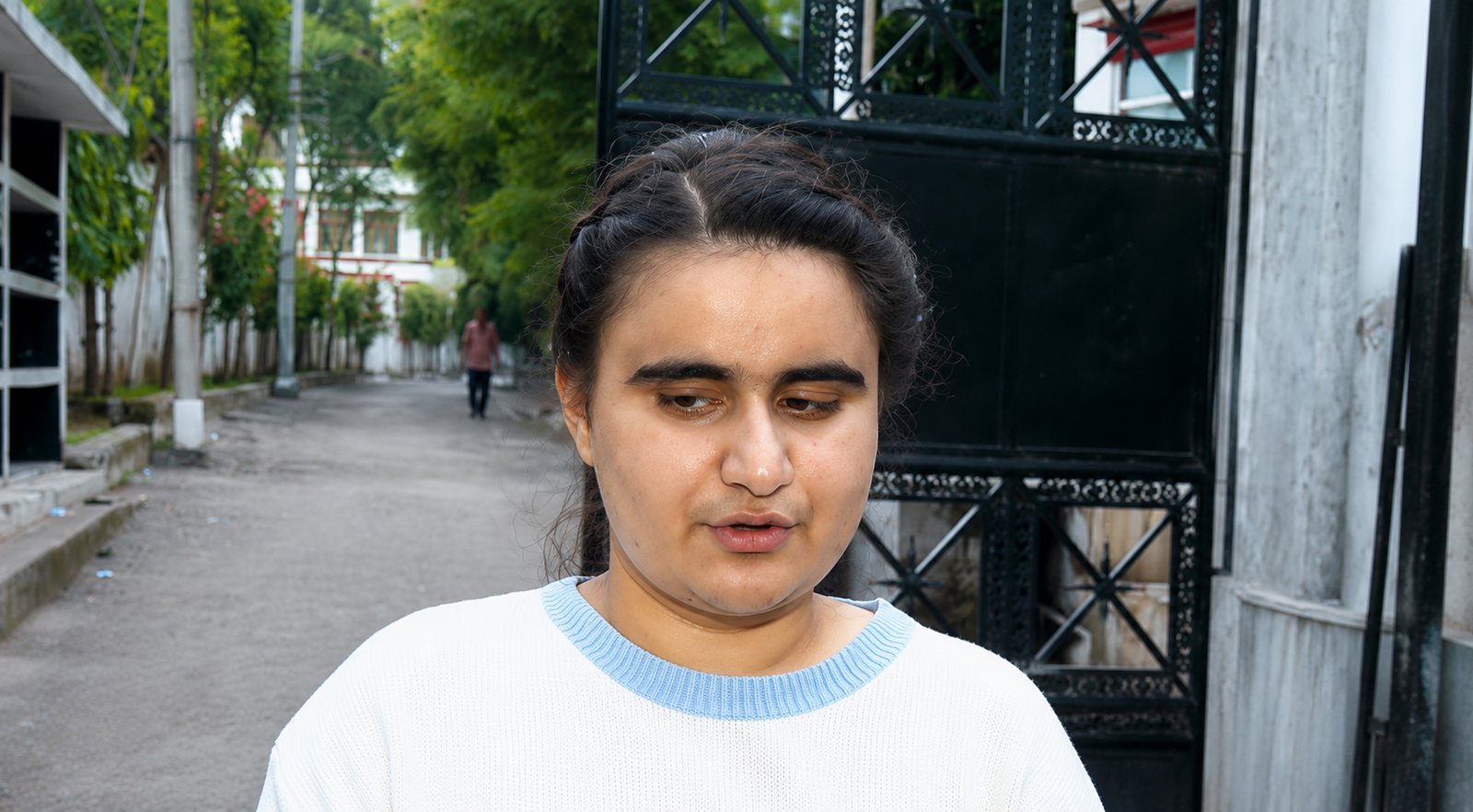
Jammu, July 18,2026- In a remarkable story of determination and resilience, Sukriti Suri, a visually impaired scholar from Jammu, appeared for the CSIR-UGC National Eligibility Test (NET) in Mathematics after receiving permission to use a Braille typewriter (Brailler) during the examination. Her journey has drawn attention to the importance of making competitive examinations more accessible for persons with disabilities.
Visually impaired since childhood, Sukriti has consistently excelled in academics despite numerous challenges. She scored an impressive 98 per cent in Class 12 and has continued to pursue higher education with unwavering determination. Her latest appearance in the CSIR-UGC NET examination marks a significant step towards ensuring equal opportunities for candidates with visual impairments.
Speaking after the examination, Sukriti explained that the CSIR-UGC NET is a crucial examination for candidates seeking admission to PhD programmes, eligibility for Assistant Professor positions, and the prestigious Junior Research Fellowship (JRF).
Previous Attempts Hindered by Lack of Accessible Tools
Sukriti revealed that she had attempted the examination twice in the past but faced serious difficulties because she was unable to perform mathematical calculations independently.
“Today’s examination was the CSIR-NET in Mathematics. This examination determines eligibility for PhD admissions, lectureship, and JRF. I had tried to appear for it twice earlier, but because my subject is Mathematics, I needed to do rough work independently. While other students were given rough sheets, they were of no use to me. I needed a Braille device, and because I did not have one, my previous two attempts did not go well—not because I was unprepared, but because I had no provision to do rough work independently,” she said.
She added that after explaining her requirement to the authorities, she was granted permission to use a Brailler, allowing her to independently solve mathematical problems during the examination.
What is a Brailler?
Sukriti explained that the device she used is known as a Brailler, a mechanical Braille typewriter designed to emboss Braille characters directly onto paper.
According to her, the device has existed for decades and is widely used in several countries.
“The device is called a Brailler. It is not a new device; it has been in use in Western countries since the 1950s. However, because of its cost, it is not widely available, and even where it is available, many people do not know how to use it. Whatever we write on it is embossed in Braille on the sheet instantly,” she said.
The Brailler enabled Sukriti to perform calculations independently, eliminating the barriers she had encountered during her previous examination attempts.
Need for Greater Awareness
While expressing gratitude to the examination authorities for extending cooperation, Sukriti also highlighted the lack of awareness about assistive technologies in India.
She observed that many officials had never seen a Brailler before and were unfamiliar with its purpose.
“It sounds strange that there is so little awareness in our country that even top-level officials, when they see such a device, think something magical is happening. For us, these are everyday tools, but many people have no knowledge about them. Once I explained the device, I received full cooperation from the authorities,” she said.
Her experience underscores the need for greater awareness among institutions conducting competitive examinations so that candidates with disabilities receive the support they require without unnecessary hurdles.
Education Must Be Truly Inclusive
Kritika Anand, who served as Sukriti’s examination scribe and provided support during the examination process, stressed that access to education must extend beyond legal rights.
She said inclusive education requires appropriate infrastructure, assistive technologies, and institutional support.
“Education is everyone’s right. But just giving the Right to Education is not enough. The necessary provisions and facilities should also be provided so that they can study and pursue their dreams,” Kritika said.
She noted that assistive devices and accessible examination systems play a critical role in enabling students with disabilities to compete on an equal footing.
Mother Recalls Years of Struggle
Sukriti’s mother described the emotional and challenging journey the family has undertaken since her daughter’s birth.
She recalled the uncertainty they faced after learning about Sukriti’s visual impairment but said her daughter’s determination never wavered.
“It has been a challenging journey from the beginning. When Sukriti was born and we came to know that she could not see, I kept wondering how my child would study. Reaching this stage has not been easy, but the biggest credit goes to my daughter. She never gave up, and we stood by her at every step. We always supported her wherever she needed help,” she said.
Her mother’s words reflect the importance of family support in helping children with disabilities overcome social and educational barriers.
A Story of Determination
Sukriti’s achievement is being hailed as an inspiring example of perseverance and the transformative impact of accessible educational tools.
Her journey demonstrates that academic excellence is determined by talent and hard work rather than physical limitations, provided candidates are given equal opportunities and appropriate accommodations.
Her success also reinforces the growing conversation around making India’s education and examination systems more inclusive through the use of assistive technologies, improved accessibility standards, and greater awareness among institutions.
As competitive examinations continue to play a decisive role in higher education and career opportunities, Sukriti’s experience serves as a reminder that creating an equitable environment is essential for enabling every deserving candidate to realise their potential.