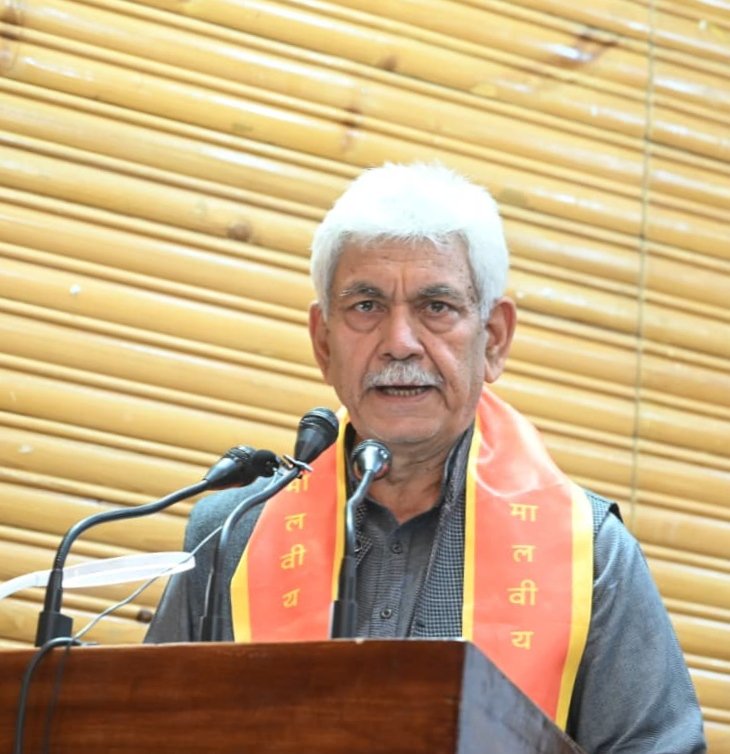
Srinagar, June 13,2026- Lieutenant Governor Manoj Sinha on Saturday attended the launch ceremony of the e-edition of the collected works of revered nationalist leader, educationist, and social reformer Mahamana Pandit Madan Mohan Malaviya in Srinagar, describing the initiative as a landmark effort to make the visionary leader’s ideas accessible to future generations through digital platforms.
The event, organized by the Mahamana Malaviya Mission, brought together academicians, policymakers, students, and members of civil society to celebrate the enduring legacy of one of India’s most respected nation-builders. The launch of the digital edition is expected to enable wider dissemination of Malaviya’s writings, speeches, and ideas among scholars, researchers, and young citizens across the country.
Speaking on the occasion, the Lieutenant Governor commended the Mahamana Malaviya Mission for undertaking the monumental task of digitizing and preserving the collected works of Pandit Madan Mohan Malaviya.
“Given the increased accessibility of digital content in today’s era, I am confident that this initiative will ensure seamless, universal access to the timeless wisdom of Mahamana,” he said.
The Lieutenant Governor delivered a keynote address on the theme “Viksit Bharat and Jammu & Kashmir: The Relevance of Mahamana’s Vision.” During his speech, he highlighted the remarkable contributions made by Pandit Malaviya toward nation-building and emphasized how his ideas continue to guide India’s developmental journey more than a century later.
A Visionary Who Shaped Modern India
Describing Malaviya as a visionary far ahead of his time, LG Sinha said the freedom fighter and education reformer did not wait for ideal circumstances to bring change. Instead, he built pathways for India’s progress through determination, sacrifice, and innovation.
“Mahamana did not inherit easy paths; instead, he forged new avenues for India’s future, laying brick by brick, making crucial decisions, and embracing personal sacrifices,” the Lieutenant Governor said.
According to LG Sinha, while many of Malaviya’s contemporaries were engaged in debates over educational reforms, industrial development, Swadeshi, and national unity, Mahamana had already begun implementing practical solutions that would strengthen India’s social and economic foundations.
The Lieutenant Governor noted that Malaviya envisioned a self-reliant and prosperous India long before independence and worked tirelessly to create institutions capable of driving national development. His efforts culminated in the establishment of educational institutions that combined scientific learning with cultural and ethical values.
Education at the Core of Nation-Building
A major focus of the Lieutenant Governor’s speech was Mahamana’s revolutionary approach to education. He highlighted that as early as 1904, Pandit Madan Mohan Malaviya had proposed a comprehensive curriculum aimed at producing engineers, scientists, agricultural experts, and skilled professionals who could contribute to India’s growth.
LG Sinha explained that Mahamana believed education should not be limited to theoretical knowledge but should equip students with practical skills required for nation-building. His educational model integrated modern engineering, industrial technology, chemical sciences, agricultural research, indigenous handicrafts, handloom traditions, arts, and India’s rich cultural heritage.
“More than a century ago, Mahamana had envisioned an education system capable of making India powerful and prosperous. Today, many of those ideas are finding expression through the National Education Policy,” the Lieutenant Governor remarked.
He observed that the National Education Policy has brought renewed emphasis on multidisciplinary learning, skill development, innovation, and research, reflecting the core principles championed by Malaviya decades ago.
The Lieutenant Governor stated that education remains the most effective instrument for social transformation and economic progress. He emphasized that India’s future competitiveness will depend largely on the quality of education and skills imparted to its youth.
Realizing Mahamana’s Dream Through Aatma Nirbhar Bharat
The Lieutenant Governor also drew parallels between Mahamana’s vision and the ongoing efforts of the Government of India to build an Aatma Nirbhar Bharat.
He said that Malaviya firmly believed in strengthening the nation through education and skill development aligned with industrial and economic requirements. According to LG Sinha, these ideas have gained renewed significance in the modern era as India seeks to establish itself as a global economic power.
“Today, the Hon’ble Prime Minister Shri Narendra Modi is working to fully realize the dreams of Mahamana. While the entire world is grappling with economic crises, India is moving forward with renewed momentum and confidence,” he said.
LG Sinha highlighted India’s growing international stature, expanding industrial base, and rapid technological advancements as evidence of the country’s progress toward self-reliance.
He noted that government initiatives focused on innovation, entrepreneurship, digital transformation, infrastructure development, and skill enhancement are helping create opportunities for millions of young Indians while strengthening the national economy.
Jammu & Kashmir Emerging as a Model of Development
A significant portion of the Lieutenant Governor’s address focused on the developmental transformation witnessed in Jammu & Kashmir over recent years.
LG Sinha asserted that under the leadership of Prime Minister Narendra Modi, Jammu & Kashmir is emerging as one of the leading regions in implementing the ideals and vision of Mahamana Pandit Madan Mohan Malaviya.
According to him, the Union Territory has undergone substantial economic, social, and institutional changes aimed at accelerating growth and improving quality of life for its residents.
“A historic industrial revolution, catalysed by the 2021 New Industrial Policy, has resulted in an influx of investments over the past four years that surpasses the cumulative industrial investments of seven decades,” he said.
The Lieutenant Governor highlighted the increasing interest shown by investors in Jammu & Kashmir and pointed out that new industrial projects are generating employment opportunities, boosting economic activity, and strengthening local entrepreneurship.
He added that infrastructure development, improved connectivity, enhanced governance mechanisms, and digital service delivery have collectively contributed to the region’s transformation.
Social Harmony and National Unity
LG Sinha underscored that Mahamana’s philosophy extended beyond economic development and education. He described national unity, social harmony, and inclusive growth as central pillars of Malaviya’s vision for India.
Drawing attention to recent developments in Jammu & Kashmir, the Lieutenant Governor stated that the Union Territory has witnessed significant societal transformation in line with these principles.
“Aligning with Mahamana’s principles of national unity, social harmony and women-led development, Jammu & Kashmir has undergone a societal transformation,” he said.
The Lieutenant Governor emphasized the importance of fostering mutual respect, communal harmony, and collective responsibility in building a stronger nation. He said sustainable progress can only be achieved when development benefits all sections of society and promotes social cohesion.
He further highlighted initiatives aimed at empowering women, encouraging youth participation, and strengthening community engagement across Jammu & Kashmir.
A Message for the Youth
Addressing students and young attendees present at the event, LG Sinha urged them to draw inspiration from the life and legacy of Mahamana Pandit Madan Mohan Malaviya.
He emphasized that India’s future will be shaped by the aspirations, innovation, and commitment of its youth and encouraged them to actively contribute to the nation’s development.
The Lieutenant Governor outlined five key pillars that young people should adopt to achieve personal success and contribute meaningfully to society.
The first pillar, he said, is the continuous pursuit of knowledge and skills aligned with evolving industrial and technological needs.
The second pillar involves cultivating personal integrity, honesty, and ethical values in all aspects of life.
The third pillar focuses on developing an entrepreneurial mindset capable of identifying opportunities and creating solutions to societal challenges.
The fourth pillar is active participation in community service and social initiatives that strengthen society.
The fifth pillar emphasizes promoting national unity, collaboration, and social harmony across communities and regions.
“These five principles can guide young people toward becoming responsible citizens and active contributors to the vision of a developed India,” he said.
Scholars and Dignitaries Attend Ceremony
The event witnessed the participation of several prominent academicians and dignitaries associated with higher education institutions and the Mahamana Malaviya Mission.
Among those present were Shri Prabhu Narain Srivastava and Shri Kamal Nain Rai, Patrons of the Mahamana Malaviya Mission; Shri Hari Shankar Singh, President of the Mission; Prof. Umesh Rai, Vice Chancellor of the University of Jammu; Prof. Nilofer Khan, Vice Chancellor of the University of Kashmir; and Prof. A. Ravinder Nath, Vice Chancellor of the Central University of Kashmir.
Faculty members, scholars, students, senior police officers, and civil administration officials also attended the programme.
Preserving a Legacy for Future Generations
The launch of the e-edition of Mahamana Malaviya’s collected works marks an important step toward preserving and promoting the intellectual and cultural legacy of one of India’s greatest nation-builders.
By making his writings available in digital format, the initiative seeks to ensure that future generations can access and learn from his thoughts on education, social reform, national unity, and economic development.
As India advances toward the goal of becoming a developed nation, the ideas articulated by Mahamana more than a century ago continue to resonate with contemporary challenges and aspirations. The event in Srinagar not only celebrated his legacy but also reinforced the relevance of his vision in shaping the future of Jammu & Kashmir and the nation as a whole.
Through his address, Lieutenant Governor Manoj Sinha reiterated that the ideals of education, self-reliance, social harmony, and national service championed by Mahamana Pandit Madan Mohan Malaviya remain essential guiding principles for building a stronger, more prosperous, and inclusive India.