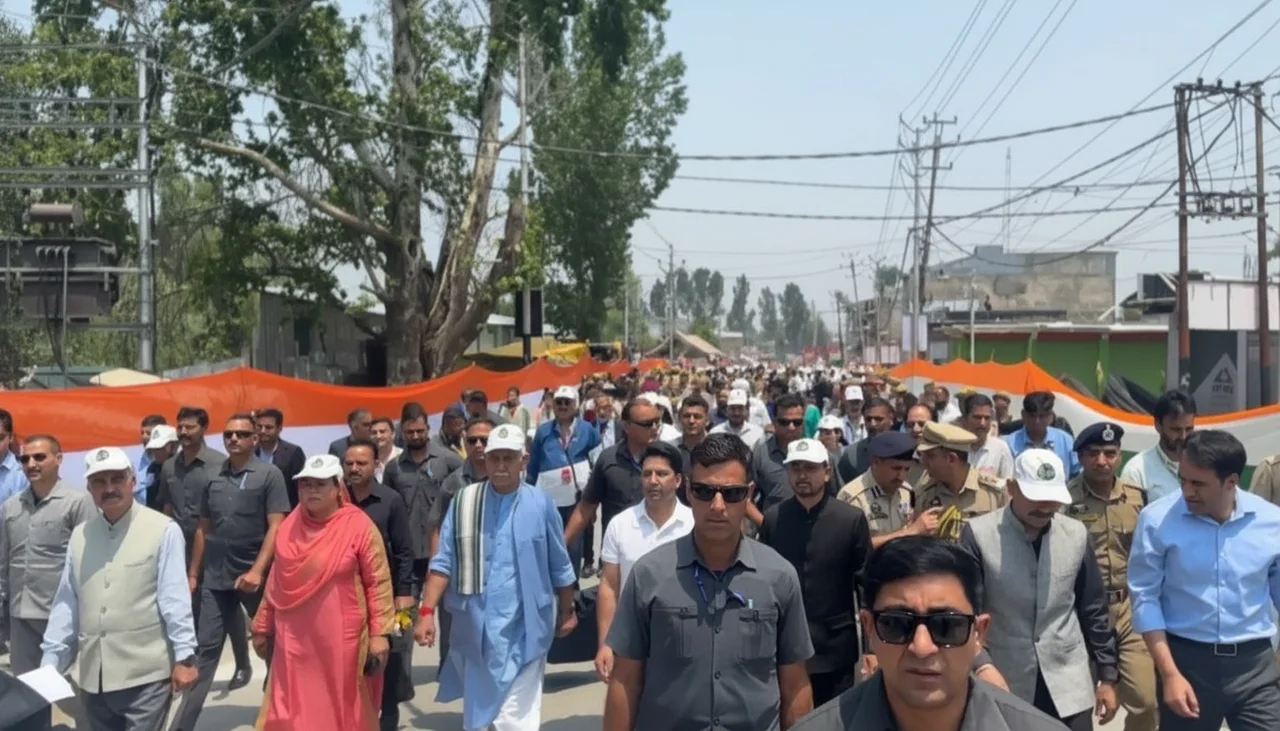
Kulgam, June 1,2026- What started as a pledge against drug abuse has now evolved into one of the most significant public movements in Jammu and Kashmir’s recent history. The Nasha Mukt Jammu Kashmir Abhiyaan, launched just 51 days ago, has rapidly transformed into a people’s movement that is uniting citizens across regions, religions, and communities in a common mission to build a drug-free future.
Addressing a massive public gathering at Laroo Bus Stand in Kulgam district, Lieutenant Governor Manoj Sinha said the campaign has moved far beyond a government initiative and has become a collective social movement powered by the people of Jammu and Kashmir.
Describing himself as “a member of your family,” the Lieutenant Governor assured citizens that the administration stands shoulder to shoulder with them in the fight against drug addiction and narcotics abuse.
“I stand before you as a member of your family to support your struggle and your dream of a safe, secure and Nasha Mukt Jammu and Kashmir,” Sinha said while addressing the gathering.
From a Pledge to a People’s Revolution
The anti-drug campaign began with a simple but powerful commitment—to protect Jammu and Kashmir’s youth from the growing threat of drug addiction. Over the past several weeks, that commitment has grown into a large-scale social movement involving families, students, teachers, religious leaders, community organizations, and ordinary citizens.
According to the Lieutenant Governor, the campaign’s greatest achievement is not merely the number of arrests or enforcement actions but the way it has united society around a common cause.
“With the support of the citizens of Jammu and Kashmir, a movement has taken shape that has united every street, every family and every heart with one common intention—to make our villages and cities free from drugs,” he said.
The statement reflects a growing public sentiment across Jammu and Kashmir that drug addiction is not simply a law-and-order issue but a social challenge that requires collective action.
A Growing Threat to Society
For decades, Jammu and Kashmir has faced numerous challenges, including terrorism and violence. However, in recent years, drug addiction has emerged as another serious threat affecting communities across the Union Territory.
Speaking on the issue, the Lieutenant Governor noted that while terrorism sought to destabilize society from the outside, drug addiction was gradually weakening society from within by targeting young people and destroying families.
“Jammu and Kashmir has endured unimaginable attacks of terrorism for many years. We also saw how drugs were slowly trapping our youth and weakening society,” he said.
Experts believe that narcotics abuse has social, economic, and psychological consequences that extend beyond individual users. Families suffer emotional trauma, educational performance declines, crime rates increase, and communities face long-term social challenges.
Recognizing the severity of the issue, the administration intensified anti-drug efforts in line with the Nasha Mukt Bharat Abhiyaan launched by Prime Minister Narendra Modi in 2020.
Youth at the Centre of the Movement
One of the defining features of the Nasha Mukt J&K campaign has been the active participation of young people.
Across districts, students and youth organizations have organized awareness rallies, seminars, workshops, sports events, and social media campaigns to educate their peers about the dangers of drug abuse.
According to the Lieutenant Governor, one of the most encouraging developments has been the growing confidence among young people who are now openly rejecting addiction and promoting healthy lifestyles.
“In the last 51 days, I have seen confidence in the eyes of our youth. Society is standing up against this menace,” he said.
Youth clubs formed by district administrations have emerged as important drivers of awareness at the grassroots level. Their efforts have helped spread the anti-drug message to schools, colleges, villages, and urban neighborhoods.
Whole-of-Society Approach
The administration has adopted what the Lieutenant Governor described as a “whole-of-government and whole-of-society approach.”
Under this model, government departments, law enforcement agencies, schools, colleges, healthcare institutions, religious organizations, women’s groups, and civil society organizations are working together to address the problem.
The Lieutenant Governor praised district administrations for establishing local committees and involving community stakeholders in awareness and prevention efforts.
“Many families, schools, social and religious leaders and public representatives are united against drugs. The committees formed by district administrations, especially women’s committees and youth clubs, are playing a major role in this movement,” he said.
This collaborative model has helped create widespread awareness and encouraged citizens to become active participants rather than passive observers.
Major Crackdown on Drug Networks
Alongside awareness initiatives, authorities have intensified enforcement measures against narcotics traffickers and organized drug networks.
The Lieutenant Governor revealed that anti-narcotics operations conducted over the past 50 days have yielded significant results.
According to official figures:
- 923 FIRs have been registered under anti-narcotics laws.
- More than 1,000 drug peddlers have been arrested.
- Over 56 major drug traffickers have been detained under preventive measures.
- Administrative action has been initiated against several individuals involved in narcotics networks.
- More than 600 driving licences linked to narcotics offenders have been suspended.
- 124 passport revocation cases have been processed.
These figures indicate the scale of the ongoing crackdown and demonstrate the administration’s commitment to dismantling drug supply chains across Jammu and Kashmir.
“With the support of the people, we have been able to identify and dismantle several drug networks. Strong action is being taken against those involved in the narcotics trade,” Sinha said.
Linking the Fight Against Drugs and Narco-Terrorism
Security experts have repeatedly warned about the links between narcotics trafficking and broader security challenges.
Illegal drug networks often generate funds that can be used to support criminal and anti-national activities. Consequently, the fight against drugs is increasingly viewed as part of a broader effort to strengthen social stability and security.
The Lieutenant Governor emphasized that protecting young people from addiction is essential not only for public health but also for safeguarding the future of Jammu and Kashmir.
The administration’s anti-drug strategy therefore combines law enforcement action with community participation, prevention, rehabilitation, and awareness.
Addicts Are Victims, Not Criminals
While speaking firmly about action against drug traffickers, the Lieutenant Governor adopted a compassionate tone regarding individuals struggling with addiction.
He stressed that drug-dependent youth should not be viewed as criminals but as victims who deserve support, dignity, and opportunities for recovery.
“The youth addicted to drugs have the right to live their lives with dignity. They should not be viewed as criminals. They are real victims and must be treated with respect, compassion and care,” he said.
The statement reflects a growing understanding that addiction is a health and social issue that requires rehabilitation alongside enforcement measures.
Experts argue that successful anti-drug strategies must balance strict action against traffickers with compassionate treatment for those affected by substance abuse.
Expanding Rehabilitation Infrastructure
Recognizing the need for comprehensive recovery services, the administration has announced plans to strengthen rehabilitation infrastructure across Jammu and Kashmir.
The Lieutenant Governor assured citizens that modern de-addiction and rehabilitation facilities would be expanded and established in every district.
“The rehabilitation centres have to be expanded and the best facilities must be made available in every district as soon as possible,” he said.
The administration has also formulated a rehabilitation policy in consultation with experts from across the country.
The policy focuses on treatment, counseling, emotional support, skill development, and social reintegration for recovering addicts.
Officials believe that providing individuals with opportunities to rebuild their lives is critical for breaking the cycle of addiction and preventing relapse.
Building a Drug-Free Future
Despite the progress made so far, authorities acknowledge that eliminating drug addiction entirely will require sustained effort over many years.
The Lieutenant Governor clarified that the current 100-day campaign was designed primarily to raise awareness and mobilize public participation rather than achieve immediate elimination of the problem.
“We know Jammu and Kashmir cannot become addiction-free in just 100 days. But this campaign was started to build awareness and strengthen the collective resolve of society so that people, police and administration work together against drugs,” he said.
The campaign’s success demonstrates the power of collective action. By involving citizens directly in prevention, awareness, and reporting efforts, the movement has created a sense of ownership among communities.
The Road Ahead
As the campaign enters its next phase, the administration remains committed to maintaining momentum and expanding outreach efforts.
Awareness programmes, community engagement initiatives, school-based interventions, enforcement actions, and rehabilitation services are expected to continue across Jammu and Kashmir.
The Lieutenant Governor made it clear that the fight against drugs will not stop until narcotics networks are completely dismantled.
“As long as even one group involved in drugs exists in Jammu and Kashmir, this campaign will continue,” he said.
What began as a simple pledge has now become a powerful social movement. Through the participation of citizens, youth, families, educators, religious leaders, and government institutions, Jammu and Kashmir is witnessing the rise of a collective effort to reclaim communities from the grip of addiction.
The Nasha Mukt J&K movement stands today as a symbol of hope, determination, and public unity—an example of how society can come together to confront one of its most serious challenges and build a safer, healthier future for generations to come.