Srinagar, May 11,2026 – At a time when many traditional Kashmiri crafts are struggling to survive amid changing lifestyles and the growing use of synthetic products, a young postgraduate student from the interiors of Dal Lake is helping keep her family’s decades-old Waguv-making tradition alive.
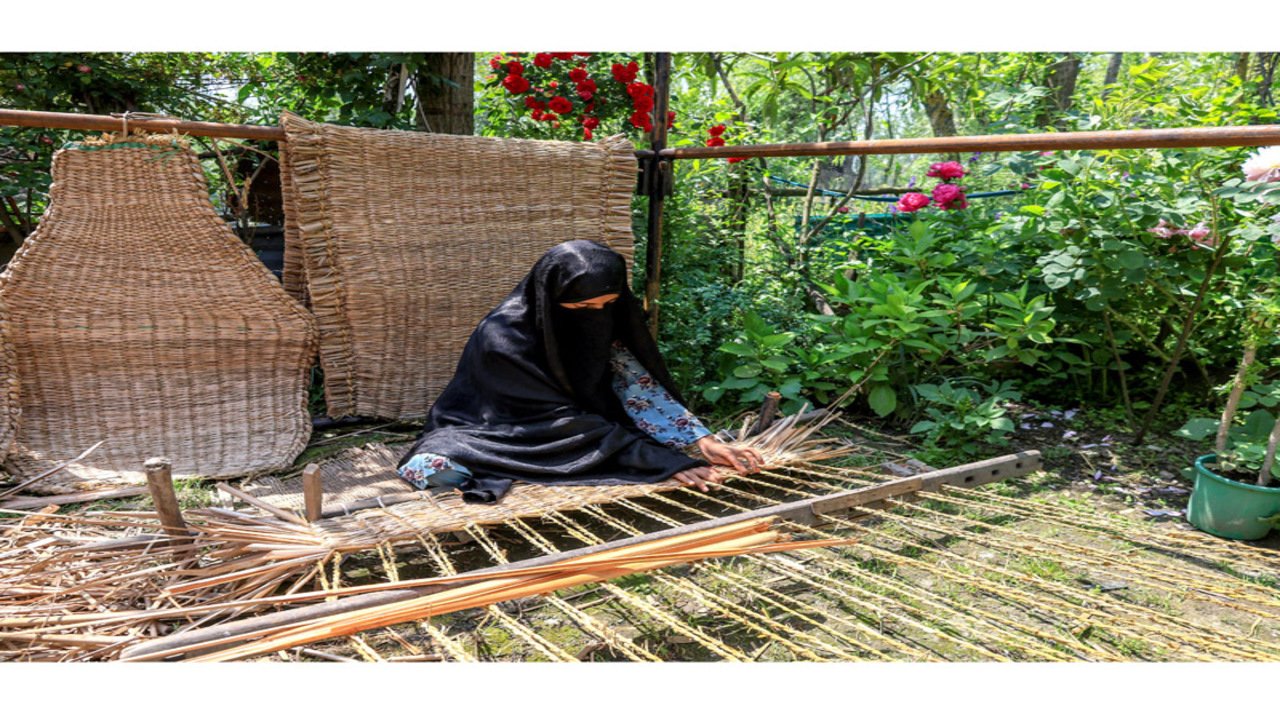
Twenty-four-year-old Tanzeela, a resident of Mir Behri in Srinagar’s Rainawari area and a postgraduate student in Persian at University of Kashmir, divides her time between academics and assisting her family in making Waguv — a traditional handmade Kashmiri mat crafted from locally sourced natural material.
For the past two to three years, Tanzeela has been independently involved in the craft, which has been part of her family’s livelihood for generations. She said her interest in Waguv-making began during her school days while helping her parents at home.
“Whenever I had free time after school, I would sit with my father and learn the craft. Gradually, I became more interested because everyone at home was associated with this work,” she said.
Her father has been practising the craft for nearly four decades, while previous generations of the family also relied on it for sustenance. Today, her mother and a few hired workers continue to assist in the weaving process at their modest home near Dal Lake.
According to Tanzeela, completing a single Waguv depends on its size and the amount of uninterrupted work possible during the day.
“If someone works continuously from morning till evening, one piece can be completed in a day. But because of household responsibilities and other work, it usually takes two to three days,” she explained.
Inside the family home, bundles of dried raw material are carefully stacked as family members work side by side weaving the mats by hand. The quiet rhythm of weaving and the earthy smell of natural fibres reflect a craft that continues to survive largely through dedication and family-based labour.
Locals associated with the occupation said only a handful of families around Dal Lake remain involved in Waguv-making today. They said declining public interest, lack of proper marketing support and competition from cheaper machine-made and synthetic products have pushed many artisans away from the traditional occupation.
Despite these challenges, Tanzeela believes traditional crafts can become a meaningful source of self-employment for educated youth in Jammu & Kashmir if provided adequate support and promotion.
She said preserving indigenous crafts is not only important for sustaining livelihoods but also for protecting Kashmir’s rich cultural heritage and identity.
Her efforts are now being appreciated by residents and artisans alike, who view her commitment as a positive example of how younger generations can help revive and preserve Kashmir’s fading traditional crafts.