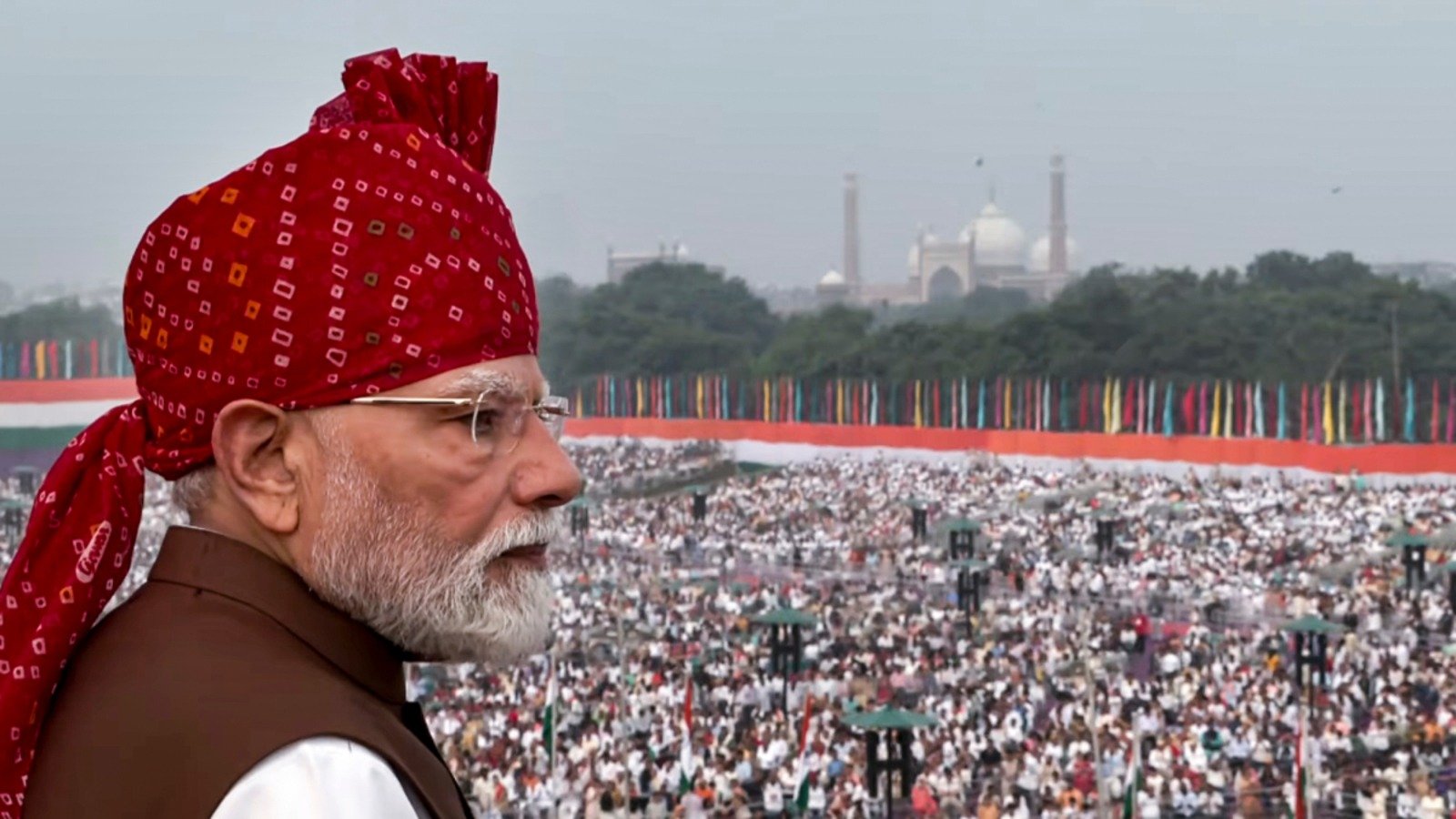
Kashmir , August 15,2026-Saptadhara is Prime Minister Narendra Modi’s new seven-stream roadmap for India’s development, unveiled from the Red Fort on Independence Day.
He invoked an ancient metaphor to frame a modern national mission. Recalling the era when India’s strength was understood through the saptasindhu — the seven rivers that nourished its early civilisational self-reliance — he declared that the country must now advance with Saptadhara, seven streams of strength, to realise a Viksit Bharat by 2047. “We need to increase the speed of reforms,” he said. “This is not a compulsion or buzz-word, it is our conviction. We are aboard the reform express.” In the next five to seven years, he argued, India must achieve what it could not in the past five to seven decades, channelling the energy of its youth into a holistic push for scale, self-reliance and global relevance.
The Saptadhara formulation is more than rhetorical flourish. It consolidates existing initiatives — Make in India, Gati Shakti, Atmanirbhar Bharat, digital public infrastructure — into a coherent architecture for the centenary of Independence. Each stream addresses a structural bottleneck while reinforcing the others. Together they seek to transform India from a large emerging market into a high-value producer, innovator, secure power and cultural force capable of shaping global outcomes rather than merely adapting to them.
Stream One — Manufacturing: Cost, Quality, Scale
The first stream of Saptadhara is manufacturing. Modi was unambiguous: India must own the entire value chain, from components and design to finished products. Factories must compete on cost, quality and scale; products must meet global standards of precision, user-friendliness and zero-defect reliability. Packaging and presentation should attract international buyers. “Precision and zero-defect manufacturing should be our identity. We should be known for quality, this should be our calling card,” he said.
This is a deliberate shift from assembly-led growth toward deep industrial capability. India’s electronics and mobile phone production have already expanded dramatically, yet dependence on imported components remains high. Building domestic component ecosystems, strengthening MSMEs in the supply chain, and embedding a quality culture will determine whether India becomes a trusted node in global supply chains or remains a secondary assembler. Success in this first stream of Saptadhara multiplies employment, reduces vulnerability to external shocks, and generates the fiscal resources needed for the other six.
Stream Two — Farming and Food Processing
The second stream turns to agriculture and food processing. Modi highlighted the sector’s potential to underpin a developed nation, stressing extensive food processing and access to global markets for Indian farmers. Agriculture still employs a large share of the workforce and remains central to rural prosperity and food security. Moving beyond primary production into value-added processing — ready-to-eat foods, branded spices, processed millets, fruits and dairy — can raise farm incomes, reduce wastage and capture higher margins in export markets.
This requires continued investment in cold chains, logistics, quality certification and farmer producer organisations. It also demands alignment with consumer preferences in developed markets for traceability, sustainability and nutrition. If executed well, this stream converts India’s agricultural strength into a source of foreign exchange and rural employment rather than a residual sector.
Stream Three — Technology and Innovation
The third stream of Saptadhara is technology and innovation. In an era defined by space, quantum computing, robotics and artificial intelligence, Modi insisted India must become an innovation hub rather than a mere market. Digital public technologies developed at home — UPI and the broader digital public infrastructure — should be taken to the world. “Made in India 6G should reach all corners,” he said.
This is both opportunity and necessity. India’s large talent pool, low-cost data and growing startup ecosystem provide advantages, yet the country still lags in deep-tech research intensity and original intellectual property in frontier domains. Building quantum and semiconductor capabilities, expanding data-centre capacity, and fostering industry-academia collaboration will decide whether India shapes the next wave of technology or remains a consumer of it. This stream also underpins the others: advanced manufacturing, precision defence systems and green technologies all depend on domestic innovation capacity.
Stream Four — Gati Shakti: Seamless Connectivity
The fourth stream is Gati Shakti — the national master plan for multi-modal connectivity. Modi called for high-speed rail linking cities, modern highways, inland waterways, multi-modal logistics and ports-led development. Seamless, fast movement of goods and people is the circulatory system of a large economy. Without it, manufacturing clusters remain isolated, agricultural produce perishes, and defence logistics suffer.
Significant progress has already been made under the Gati Shakti framework. The next phase requires sustained capital expenditure, last-mile integration, and efficient operation of new assets. Ports-led development, in particular, can turn India’s long coastline into an engine of trade and industrial growth rather than a peripheral advantage — a theme that resurfaces later in the seventh stream of Saptadhara as well.
Stream Five — Raksha Shakti: Defence Self-Reliance
The fifth stream is Raksha Shakti. In a world where every nation prioritises its own interests, Modi argued, self-reliance in defence is an imperative. India must develop drones, hypersonic technologies and cyber-security capabilities, harnessing the energy of its youth. The goal is not only to reduce import dependence but to become a global supplier of advanced defence systems.
Defence production has grown substantially in recent years, and indigenous platforms have demonstrated capability. Scaling this into a comprehensive ecosystem — covering design, materials, electronics, propulsion and software — requires long-term commitment, private sector participation and a skilled workforce. Cyber security, increasingly a domain of asymmetric warfare, demands continuous talent pipelines. A strong Raksha Shakti stream both secures the nation and generates high-technology spin-offs for civilian industry.
Stream Six — Green and Blue Economy
The sixth stream combines the green and blue economies. India must pursue green mobility and green manufacturing while offering solutions to global warming. Simultaneously, the blue economy — coastal tourism, fisheries and ocean technologies — offers significant opportunity along India’s extensive coastline. New “green jobs” can emerge from both.
This stream aligns economic ambition with environmental responsibility. Leadership in green hydrogen, energy storage, renewable manufacturing and sustainable coastal development can create exportable technologies and services while addressing domestic energy security and climate vulnerability. Execution will require coherent policy across energy, industry, shipping and tourism ministries, and careful management of ecological limits.
Stream Seven — Soft Power: Culture as Strategic Asset
The seventh and final stream of Saptadhara is soft power. Yoga has already connected the world to India’s civilisational energy. Holistic healthcare under the “Heal in India” banner, films, the creative industries, gaming, national parks and a growing concert economy all hold untapped potential. “We have over a 100 national parks, but to attract global tourists, we have fallen short. We have the capability to do it,” Modi noted. The concert economy is expanding; India should enable major artists to perform here.
Soft power is not decorative. In an interconnected world it shapes narratives, attracts talent and investment, and builds goodwill that hard power alone cannot. Expanding cultural exports, improving tourism infrastructure and quality of experience, and professionalising creative industries can generate employment and enhance India’s global standing without the resource intensity of heavy industry.
A Coherent Architecture, Not Isolated Silos
What distinguishes Saptadhara from earlier slogans is its insistence on holistic application. Progress in one stream reinforces the others. Advanced manufacturing needs skilled workers trained through the innovation ecosystem and moved efficiently by Gati Shakti networks. Defence self-reliance draws on the same technological base. Green technologies require manufacturing scale and research depth. Soft power amplifies the attractiveness of Indian products, tourism and investment destinations. Youth power is the common catalyst across all seven streams of Saptadhara.
The timeline is deliberately compressed. The next five to seven years are framed as decisive. This urgency reflects both opportunity — demographic dividend, geopolitical realignments, technological flux — and risk. Execution capacity, regulatory coherence, skill development at scale, and the ability to crowd in private capital will determine outcomes. Past experience shows that Indian state capacity can deliver when missions are clearly defined and monitored; it also shows that fragmentation and bureaucratic inertia can dilute ambition.
Looking Ahead: Can Saptadhara Deliver?
Prime Minister Modi’s Saptadhara is not a new slogan layered atop existing schemes. It is an attempt to organise the country’s developmental energies around seven mutually reinforcing domains and to set a clear horizon of 2047. The parallel with saptasindhu is intentional: just as the seven rivers once defined the material basis of early Indian strength, these seven streams of Saptadhara are offered as the contemporary sources of national power.
Whether the vision materialises depends on sustained political will, administrative delivery and societal participation. For a journalist who has watched Indian economic policy evolve across three decades — from the cautious liberalisation of the 1990s through the infrastructure push of the 2000s to the current emphasis on self-reliance and scale — the Saptadhara framework is notable for its ambition and internal logic. It treats development as a multi-dimensional project rather than a single growth rate.
If the streams flow with the speed and volume the Prime Minister demands, India will approach its centenary of Independence with capabilities that match its aspirations. If they remain shallow or disconnected, the grand design of Saptadhara will join the long list of unfulfilled national blueprints. The test, as always, lies in the years of work that follow the speech — and in whether Saptadhara becomes the organising idea of India’s next decade, or simply its latest addition to the vocabulary of ambition.