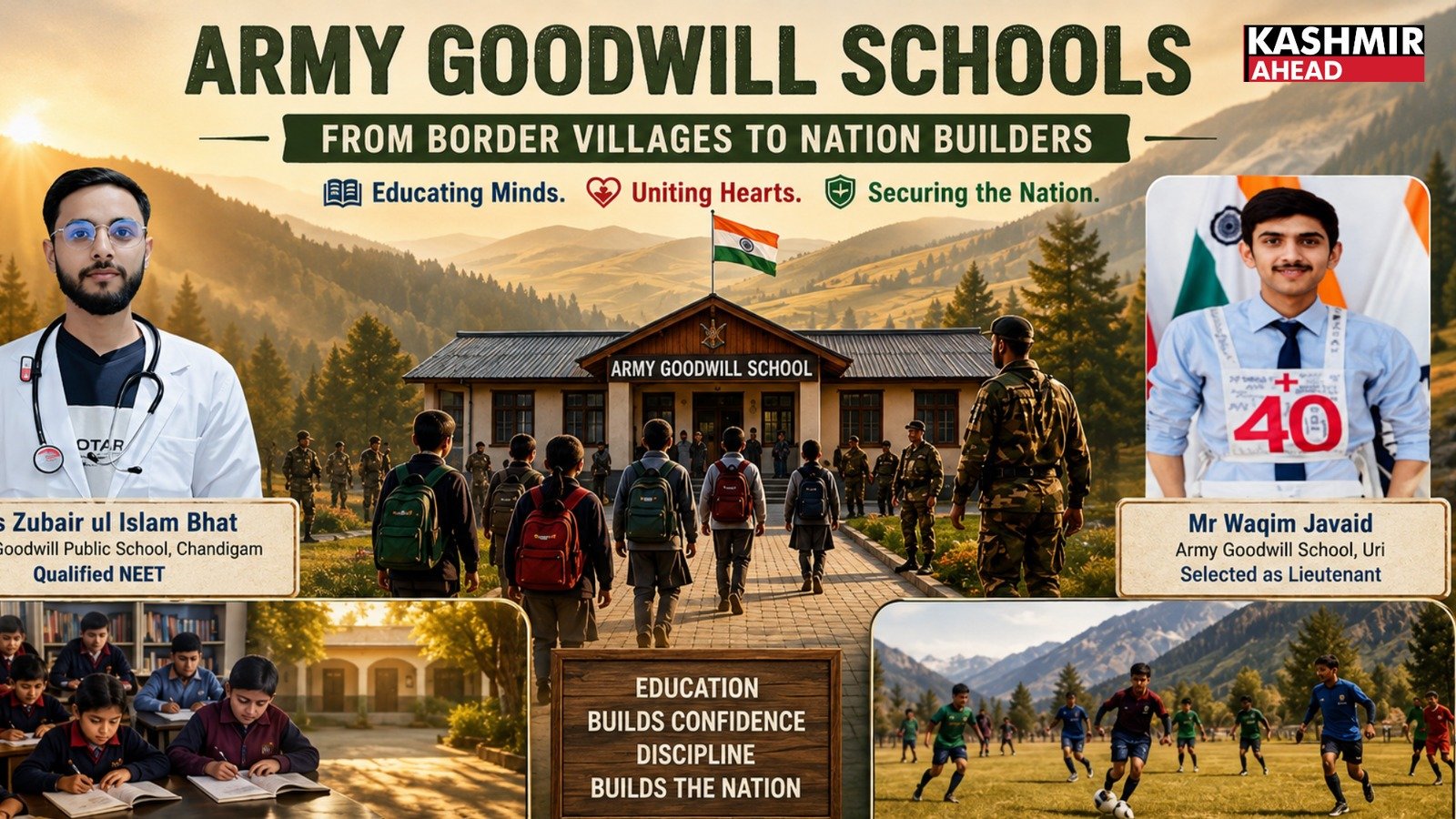
Kashmir, August 16,2026-Under Operation Sadbhavana, the Indian Army continues its two-decade mission of bringing classrooms, confidence and community bonds to India’s remote border regions through its Army Goodwill Schools.
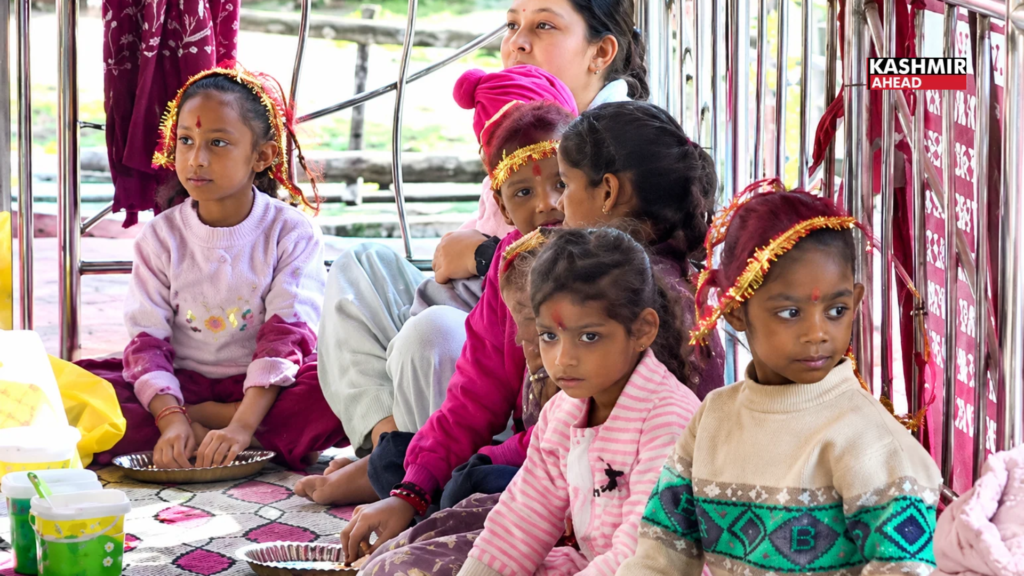
Operation Sadbhavana Army Goodwill Schools have, for over 25 years, been quietly rewriting the story of education in some of India’s most difficult terrain. In the high-altitude villages and conflict-scarred valleys of Jammu & Kashmir and Ladakh, education has long been one of the hardest things to sustain. Terrorism, militancy, harsh terrain and the sheer remoteness of border settlements have, for decades, kept schools understaffed, underfunded and, in many pockets, simply absent. The Indian Army’s Army Goodwill Schools (AGS) — run under the umbrella of Operation Sadbhavana — have worked to change that, one classroom at a time.
The Origins of Operation Sadbhavana Army Goodwill Schools
The origins of the programme lie in one of the darkest chapters of the region’s recent history. The exodus of the Kashmiri Pandit community in the early 1990s, at the height of militancy in the Valley, stripped Kashmir of a community that had traditionally formed the backbone of its education system. Teaching staff vanished from schools almost overnight, and with them went the infrastructure that generations of families had relied upon. Realising that this vacuum would cripple the career prospects of an entire generation of children, particularly those from financially weaker sections in far-flung areas who could not afford residential schooling in the cities, the Indian Army — through its Udhampur-based Northern Command — stepped in to build a parallel educational ecosystem from scratch.
That effort was formalised in 1998 as Operation Sadbhavana, a Hindi word meaning “goodwill.” It was conceived not merely as charity but as a humane response to the aspirations of a population caught between insurgency and neglect. Over the following two and a half decades, its mandate broadened well beyond classrooms to cover quality education, women’s empowerment, community and infrastructural development, health and veterinary care, upliftment of nomadic Gujjar and Bakarwal communities, and what the Army describes simply as nation-building.
Operation Sadbhavana Army Goodwill Schools: Reach and Scale
The scale of the Operation Sadbhavana Army Goodwill Schools network today reflects that ambition, even if exact figures vary slightly depending on the year and source cited. Recent assessments put the network at 43 institutions, providing education to over 16,000 students and employment to more than 900 teachers and staff. Other counts put the figure at 46 schools across Jammu, Kashmir and Ladakh, teaching roughly 14,000 students while employing over 1,000 local teachers and staff. Whichever count one takes, the trajectory is the same: a programme that began as an emergency response has grown into one of the largest civil-military education networks anywhere in India.
Beyond the schools it runs directly, the Army has also extended support to nearly 1,900 government-run schools across the region — carrying out renovation and modification work, building additional classrooms, and provisioning furniture, libraries, laboratories and other equipment that cash-strapped local administrations have struggled to provide on their own. Close to a lakh children are estimated to have received primary or higher-secondary education through this combined effort since the programme’s inception, with roughly 1,500 scholarships awarded annually to deserving students and around 840 students currently receiving sponsored education outright.
In Ladakh specifically — a region defined by its extreme altitude, thin population density and long winters that cut off many villages for months at a stretch — the Army runs seven Army Goodwill Schools educating more than 2,200 students. These are complemented by targeted initiatives such as ‘Kargil Ignited Minds,’ a programme built specifically around supporting girls’ education and preparing young women for competitive examinations in a region where such opportunities have historically been scarce.
Beyond the Classroom: The Real-World Impact of Operation Sadbhavana Army Goodwill Schools
The impact of these schools is not confined to literacy alone. AGS institutions have offered children from border and insurgency-affected areas a stable learning environment shielded from the disruptions of conflict — a promise of continuity in places where continuity itself has often been the first casualty of unrest. Their outcomes bear this out: AGS students achieved a 100% pass rate in the 2019 CBSE Class 10 examinations, a result held up repeatedly by the Army as evidence that quality education is achievable even in the most difficult operating environments.
Around these schools, Operation Sadbhavana has built out a wider ecosystem of empowerment. Women and girls in remote areas of Ladakh have been trained in vocational skills such as weaving, wool work, apricot oil extraction and yak cheese making — trades that translate directly into household income in economies where formal employment is scarce. These efforts sit alongside the Army’s broader civic-action programmes, which include medical aid camps, veterinary care for livestock-dependent households, and community centres designed to give remote villages a shared civic space they would otherwise lack.
A Community Anchor, School by School
Individual schools reflect the same pattern of grassroots reach that defines the programme as a whole. The Army Goodwill School at Karu in Ladakh, for instance, began life in 1998 as a regimental school under the Tangtse Brigade, before being formally absorbed into Operation Sadbhavana and inaugurated as a dedicated Sadbhavana institute in 2001. Its running costs are sponsored entirely through Sadbhavana funds, and its teachers — hired from the local population — are paid on a monthly honorarium basis, giving the school both an educational and an economic role in its community.
Further west, in North Kashmir, schools such as Army Goodwill School Budkot and Army Goodwill School Mazbug, both established in 2004 near Handwara and Sopore respectively, have grown into full-fledged institutions affiliated with the Jammu & Kashmir Board of Secondary Education, running classes from Nursery through Class 10 with syllabi structured around NCERT textbooks. Budkot alone now serves over 400 students and has set itself the additional goal of becoming North Kashmir’s first plastic-free school. Mazbug, established as a “model learning centre,” was designed explicitly to set a benchmark that surrounding government and private schools could aspire to. Both campuses now feature science laboratories and multipurpose auditoriums — infrastructure that would have been unthinkable in the same villages a generation ago.
These schools are administered through the Army Goodwill Education Society, a body registered under the Societies Registration Act, which oversees staffing, curriculum alignment and day-to-day operations across the network — a structure recently examined by the Jammu & Kashmir and Ladakh High Court, which held that while AGS institutions perform an undeniably public function in imparting education, they remain self-financed bodies rather than government or government-aided institutions for the purposes of contractual service disputes. The ruling, while narrow in its legal scope, underscored just how embedded these schools have become in the region’s civic and administrative fabric — significant enough to generate the kind of institutional questions usually reserved for public establishments.
Nation-Building Through Operation Sadbhavana Army Goodwill Schools
What distinguishes the Operation Sadbhavana Army Goodwill Schools initiative, officials and analysts argue, is its long-term framing: not relief, but sustained self-reliance. Where early civic-action programmes were reactive — built to plug gaps left by conflict — the initiative today is increasingly framed around durable outcomes: literacy rates, employment generation, skill development and community trust that outlast any single deployment or unit rotation. The initiative has gradually repositioned the Army’s role in the region — from a force focused purely on security to a partner in development, empowerment and progress — a shift that #IlluminatingFrontiers and #TransformingLives, the campaign hashtags accompanying recent outreach posts, seek to capture.
That repositioning matters strategically as well as socially. For years, external narratives and misinformation have shaped public perception of the Army’s role in J&K and Ladakh; the visible, measurable presence of Goodwill Schools — CBSE toppers, employed local teachers, girls preparing for competitive exams — offers a counter-narrative built on outcomes rather than assertions. It is nation-building conducted not through rhetoric, but through report cards.
Looking Ahead
The challenge now, as officials and observers alike note, is sustaining this momentum. Employment generation, infrastructure upgrades and continued investment in girls’ education will determine whether the gains of the past 25 years translate into lasting, self-sustaining growth for the region — rather than a legacy dependent indefinitely on Army sponsorship. As new academic sessions begin across J&K and Ladakh’s frontier districts, the schools stand as one of the more visible, enduring markers of that two-decade-long commitment — proof, in the Army’s own framing, that education can indeed light up even the most remote frontier.