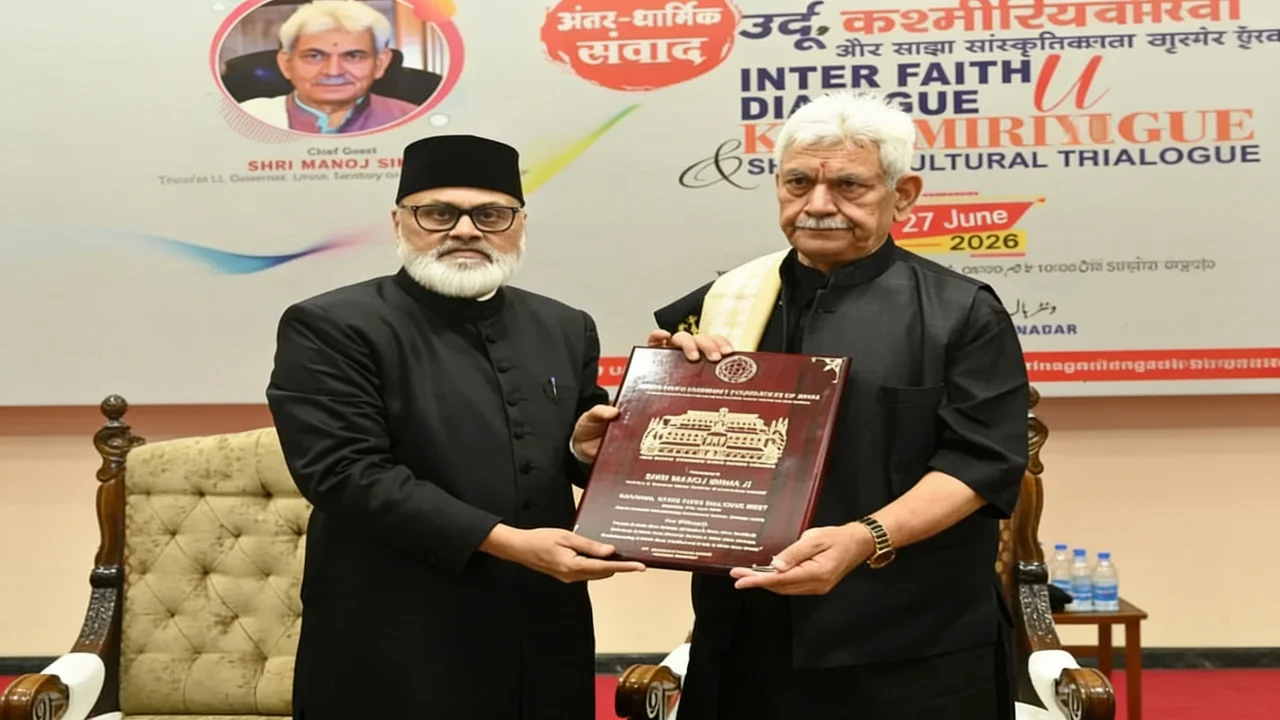
Srinagar, June 27,2026- Lieutenant Governor Manoj Sinha on Saturday said that the successful organisation of the Interfaith Dialogue in Srinagar reflects India’s timeless civilisational values of peace, wisdom, and harmonious coexistence among diverse faiths.
Addressing the gathering during the Interfaith Dialogue organised by the Council for Promotion of Urdu Language in collaboration with the Interfaith Harmony Foundation of India, the Lieutenant Governor said that India has, for centuries, served as a beacon of knowledge, spirituality, and mutual respect for humanity.
“The organisation of the Interfaith Dialogue in Srinagar is proof that India is an ancient civilisation which, for centuries, has shown humanity the path of knowledge, wisdom, and coexistence. This is the land where every religion found shelter, every faith got an opportunity to flourish, and where people have been taught to live in peace and harmony,” the Lieutenant Governor said.
He emphasised that India’s cultural heritage is rooted in the ideals of unity in diversity, where people from different religions, languages, and traditions have lived together while respecting each other’s beliefs.
Highlighting the significance of Jammu and Kashmir’s inclusive ethos, the Lieutenant Governor said the region’s rich traditions of mutual respect and shared cultural values continue to inspire society. He noted that interfaith dialogue plays a vital role in strengthening communal harmony, promoting understanding, and fostering peaceful coexistence among communities.
The Lieutenant Governor further observed that while the world today often witnesses divisions based on religion, language, and race, Indian philosophy possesses the unique ability to bridge such differences through the values of compassion, tolerance, and universal brotherhood.
He called upon people, especially the younger generation, to uphold these civilisational values and work collectively towards building a peaceful, inclusive, and progressive society.
The Interfaith Dialogue brought together religious scholars, intellectuals, community leaders, and participants from different faiths, who deliberated on promoting peace, strengthening social harmony, and preserving the pluralistic traditions that have long defined the cultural fabric of Jammu and Kashmir.