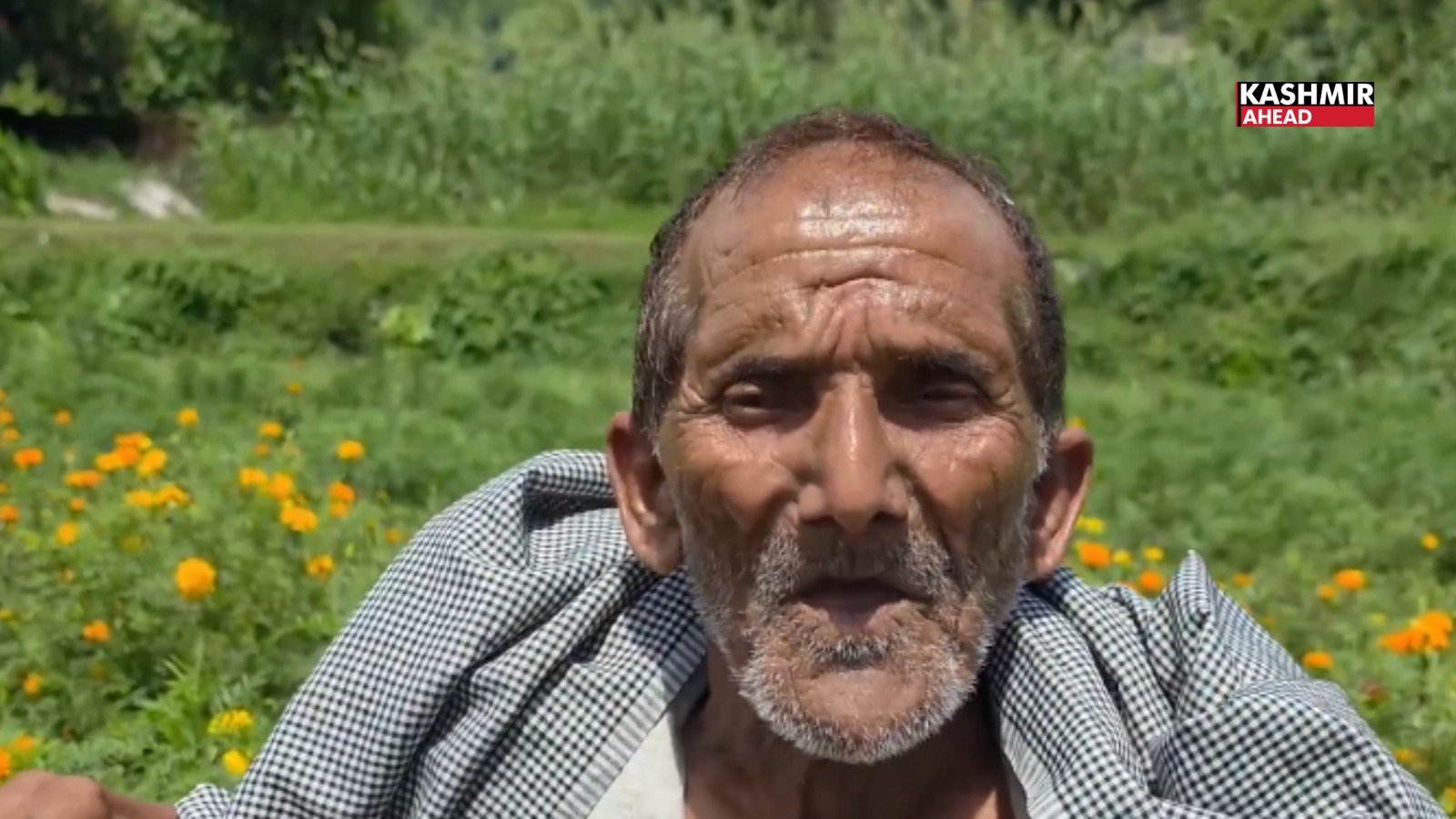
Katra, August 23,2026- The Agriculture Department in Katra, Jammu and Kashmir, is encouraging farmers to adopt floriculture alongside their traditional crops, and for 80-year-old Premu, a farmer from Bhagtha, the shift has brought a tangible improvement in his livelihood — one he attributes directly to sustained government support.
Speaking about his experience with flower cultivation, Premu said the change has meaningfully boosted his income compared to his earlier reliance on conventional farming alone. “Yes. By doing the flower business, today we are getting more benefit than before,” he said, describing how the transition to floriculture has reshaped his household’s finances in recent years.
Premu credited the government for playing a direct role in enabling this shift, pointing to the assistance extended by the Agriculture Department in the form of guidance, quality inputs and financial support. “The government has also provided help. We have benefited greatly. We have received a lot of benefit from our work,” he said, adding that the support extended beyond agricultural inputs alone.
Among the benefits he highlighted was a pension scheme that provides him with periodic financial assistance. “They have also given us pension, Rs 2,000 which they give every three months, that is also given,” Premu noted, expressing gratitude for the additional social security cushion this has provided alongside his farming income.
Reflecting on the overall experience, the elderly farmer offered his thanks to the government for its role in promoting floriculture as a viable livelihood option in the region. “So, many thanks to them, they are kind. I thank the government for promoting such businesses. They should continue doing such things in the future as well,” he said, voicing hope that similar support would continue for farmers in the years ahead.
Premu’s account reflects a broader push by the Agriculture Department to encourage farmers across Katra to diversify into floriculture, a shift that officials have said offers higher returns per unit of land compared to many traditional crops, particularly given Katra’s steady footfall of pilgrims and tourists visiting the region through the year. The presence of a consistent local market for flowers, driven in part by religious and ceremonial demand in the pilgrim town, has made floriculture an increasingly attractive proposition for local farmers willing to make the switch.
Officials associated with such initiatives in the region have previously pointed to the role of timely guidance, access to quality seeds and planting material, and coordination with local agricultural extension services in helping farmers transition successfully. For older farmers like Premu, this kind of structured support can be particularly significant, given the practical challenges involved in adopting a new form of cultivation later in life.
The government’s engagement with farmers in Katra has also included pension and welfare schemes aimed at providing a measure of financial security to elderly agricultural workers, a demographic that often continues working the land well into old age due to limited alternative income sources. Premu’s remarks suggest that such measures, taken together with agricultural support, have had a meaningful cumulative impact on farmers in the area.
As floriculture continues to gain traction in Katra, stories like Premu’s are likely to serve as encouragement for other farmers considering a similar shift, offering a real-world example of how government support, market access, and traditional farming knowledge can combine to improve rural livelihoods in the region.
For a town whose economy has long been shaped primarily by pilgrim tourism tied to the Vaishno Devi shrine, the growing emphasis on floriculture represents an attempt to diversify local income sources beyond seasonal tourism-linked work alone. By tapping into the same steady stream of visitors that sustains the town’s hospitality and retail sectors, farmers cultivating flowers are able to access a built-in local market without needing to transport their produce to distant mandis.