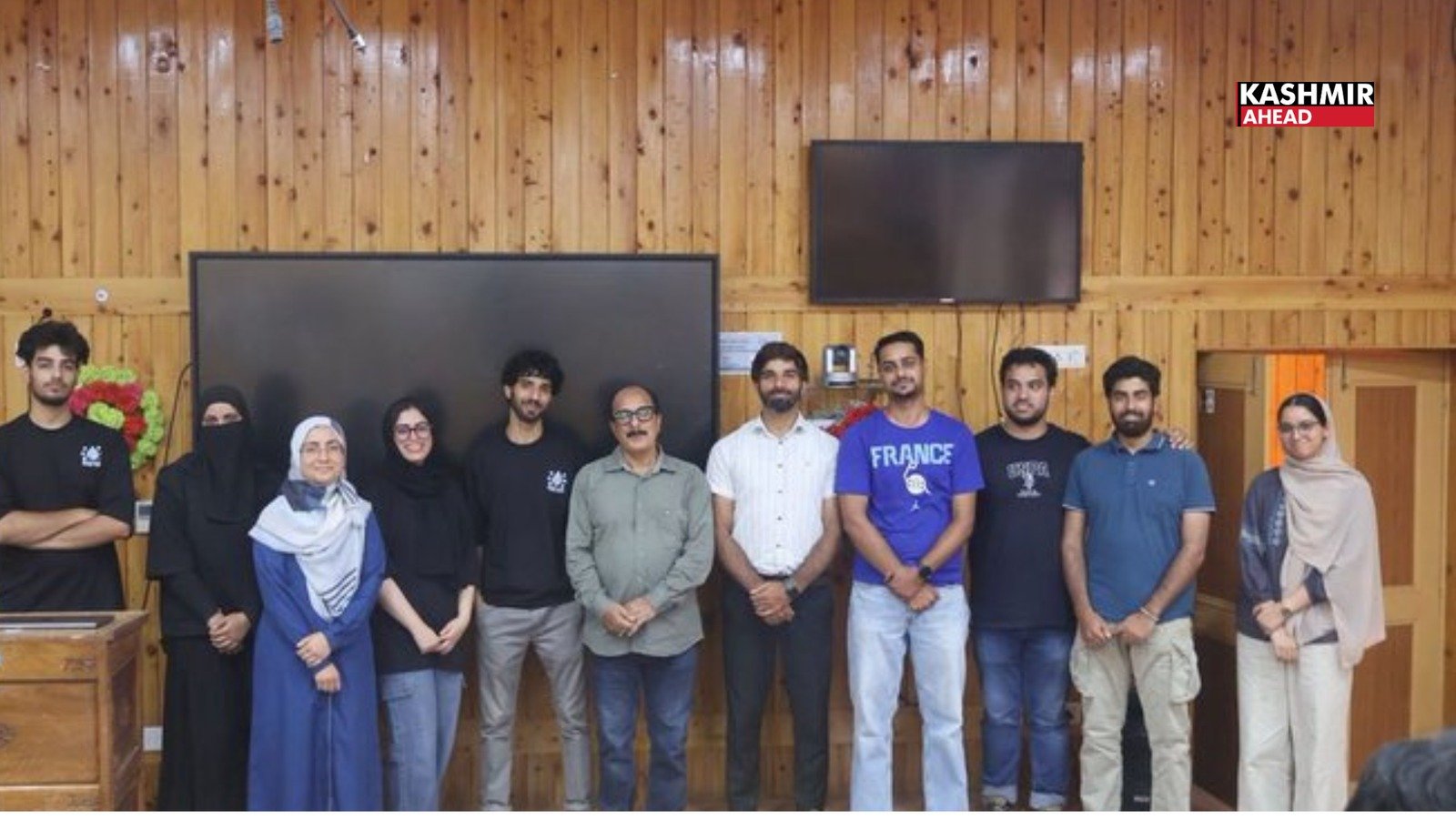
Srinagar, August 23,2026- The National Institute of Technology (NIT) Srinagar hosted KATHE 2026: AI Challenge for Kashmiri Language Translation, a national-level initiative aimed at advancing artificial intelligence and machine-learning applications for the Kashmiri language, bringing together teams from India and abroad to compete in English-to-Kashmiri machine translation.
The event brought together students, academics, linguists, technology professionals and volunteers to address the challenges associated with building AI tools for low-resource languages. Kashmiri has long been considered underrepresented in modern AI and natural language processing systems, and the challenge was designed specifically to close that gap by encouraging the development of computational models capable of handling the language’s linguistic complexity.
In a result that underscored the competition’s genuinely international character, TeamHD from Heidelberg University, Germany, secured the first position, followed by TeamIJ from IIT Jammu in second place and Team Tabaq Maaz from NIT Srinagar in third place. Three consolation awards were also presented to other participating teams, recognising the broader pool of talent that engaged with the challenge.
The event was organised by Gaash Lab, NIT Srinagar, in collaboration with the Bureau of Indian Standards (BIS), with the University of Kashmir as the academic collaborator and GitHub as the primary sponsor. The involvement of GitHub as a technology sponsor and the Bureau of Indian Standards as a collaborating institution reflects the effort to position the challenge not merely as an academic exercise, but as a step toward standardising and scaling Kashmiri-language technology for wider use.
The initiative had been in the works for several weeks before its finale. When it was first announced, organisers described the challenge as a nationwide platform for students to harness artificial intelligence and natural language processing for the preservation and advancement of Kashmiri, one of India’s low-resource languages. Competing teams were required to build, test and evaluate their machine translation models on the Kaggle platform, with an evaluation framework and competition dataset made available to registered participants ahead of submissions.
The competition drew entries from across India before culminating in an offline finale at NIT Srinagar, where shortlisted teams demonstrated their models through live evaluation. The finale also featured expert lectures and interactive sessions on artificial intelligence, natural language processing, and the specific technical challenges involved in building AI systems for low-resource languages such as Kashmiri, giving participants exposure beyond the competitive component of the event.
The programme was attended by Prof. Roohie Naaz, Dean, Research and Consultancy, NIT Srinagar, and Prof. Aadil Amin Kak, Professor of Linguistics and Director of the Sheikh-ul-Alam Centre for Multidisciplinary Studies at the University of Kashmir, among other academics and technology professionals who engaged with participants throughout the event.
Organisers have framed KATHE 2026 as more than a one-off competition — an attempt to build a lasting, collaborative ecosystem linking academia, researchers and technology stakeholders around the goal of preserving Kashmiri’s linguistic heritage while advancing its digital presence. The involvement of a Kaggle-hosted leaderboard, a public dataset and open submission framework also means the technical groundwork built during the competition could outlive the event itself, potentially serving as a resource for future researchers working on Kashmiri language technology.
That an international team from Heidelberg University claimed the top position adds a further dimension to the challenge’s outcomes, suggesting that efforts to build AI tools for Kashmiri are attracting serious interest well beyond the region and the country. For a language that has historically had limited digital and computational resources, the scale and geographic spread of participation in KATHE 2026 marks a notable step toward integrating Kashmiri more fully into India’s expanding AI and digital ecosystem.
With the first edition of the challenge now concluded, attention is likely to turn toward how the models and datasets developed during the competition can be built upon — both by the winning teams and by other researchers working to strengthen Kashmiri’s place in an increasingly AI-driven digital landscape.