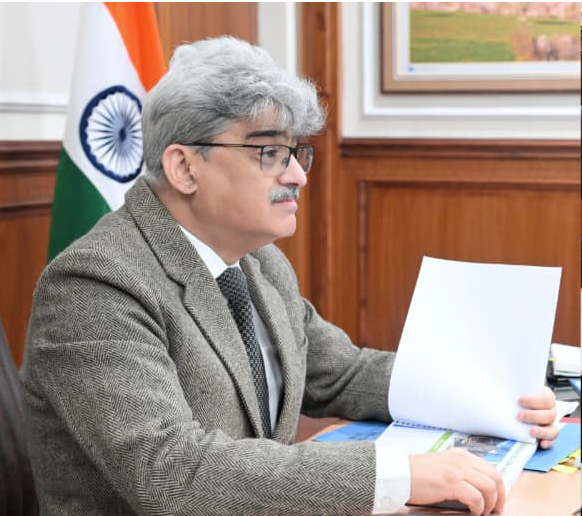
Jammu, December 6,2025: Chief Secretary Atal Dulloo chaired a comprehensive review meeting to assess the progress of major health infrastructure projects underway in the Health & Medical Education (H&ME) Department of Jammu and Kashmir. The review focused on works being executed under the Pradhan Mantri–Ayushman Bharat Health Infrastructure Mission (PM-ABHIM), the Emergency COVID Response Package-II (ECRP-II), expansion of IHIP, IPHS compliance, and development of NCDC laboratories and VRDL facilities across the UT.
The meeting was attended by the Secretary H&ME, Mission Director NHM, Principals of Government Medical Colleges, Managing Director HSCC, Director Health Services Kashmir/Jammu, and other senior officials.
During the project-wise appraisal of ongoing works, the Chief Secretary directed HSCC to aggressively scale up manpower and machinery—by at least three times—to ensure that all Critical Care Blocks (CCBs) are completed within the stipulated timeline of the Centrally Sponsored Schemes. He emphasised that fund release under PM-ABHIM and ECRP-II is directly linked to submission of Utilization Certificates, stressing full fund utilisation before scheme closure.
Reviewing physical and financial progress since the previous assessment in June 2025, the Chief Secretary instructed HSCC to intensify field visits and on-ground monitoring. He highlighted that over ₹800 crore under PM-ABHIM and ₹166 crore under ECRP-II are currently under execution, and timely completion is crucial as such large funds cannot be arranged later.
He also called for improving IPHS scores across health facilities, noting that higher certification directly enhances healthcare quality and public confidence. Stressing the importance of disease surveillance and diagnostics, he directed fast-tracking of NCDC labs in Jammu and Srinagar.
Providing updates, the Secretary H&ME said that procurement of equipment is being planned to ensure immediate operationalisation once infrastructure is complete. Under PM-ABHIM, two 100-bedded CCBs are under construction at GMC Jammu and District Hospital Budgam, while seven 50-bedded CCBs are coming up at GMC Kathua, GMC Rajouri, GMC Doda, GMC Anantnag, SKIMS Medical College Bemina, and District Hospital Kulgam. Additionally, 20 District Integrated Public Health Labs (DIPHLs) and 287 Block Public Health Units (BPHUs) are being established across Jammu & Kashmir.
Under ECRP-II, work is in progress on seven more 50-bedded CCBs at GMC Udhampur and the District Hospitals of Reasi, Pulwama, Kupwara, Poonch, Shopian, and Ganderbal.
Mission Director NHM Baseer-ul-Haq Choudhary presented location-wise progress of CCBs and DIPHLs, reporting improved execution and frequent field inspections. The meeting also reviewed the establishment of 79 Urban Ayushman Arogya Mandirs (UAAMs), of which 53 have been completed, with the remaining targeted for completion by March 2025.
The SNO NHM, Dr. Harjeet Rai, briefed the Chief Secretary on the performance of the Integrated Health Information Platform (IHIP)—a digital surveillance system of the Union Health Ministry. Jammu and Kashmir ranks among the top five States/UTs in the country, with 3,796 health facilities mapped onto the platform enabling real-time tracking of syndromic, presumptive, and lab-confirmed cases. Over the past year, 133 outbreaks affecting 3,250 individuals and resulting in 8 deaths were recorded through IHIP, which also tracks dog bite, snake bite, and dengue cases in real time.
Progress on NCDC labs at Kot Bhalwal (Jammu) and Srinagar was also reviewed. Regarding IPHS compliance, it was informed that 3,526 out of 3,533 health facilities have been assessed—1,992 scoring between 50–69%, 198 between 70–79%, and 160 scoring above 80%, the highest certification bracket.
The Chief Secretary also reviewed the functioning of Viral Research & Diagnostic Laboratories (VRDLs) at GMC Jammu and GMC Srinagar, noting their expanding diagnostic capabilities and ongoing research on viruses including Influenza and Rotavirus.