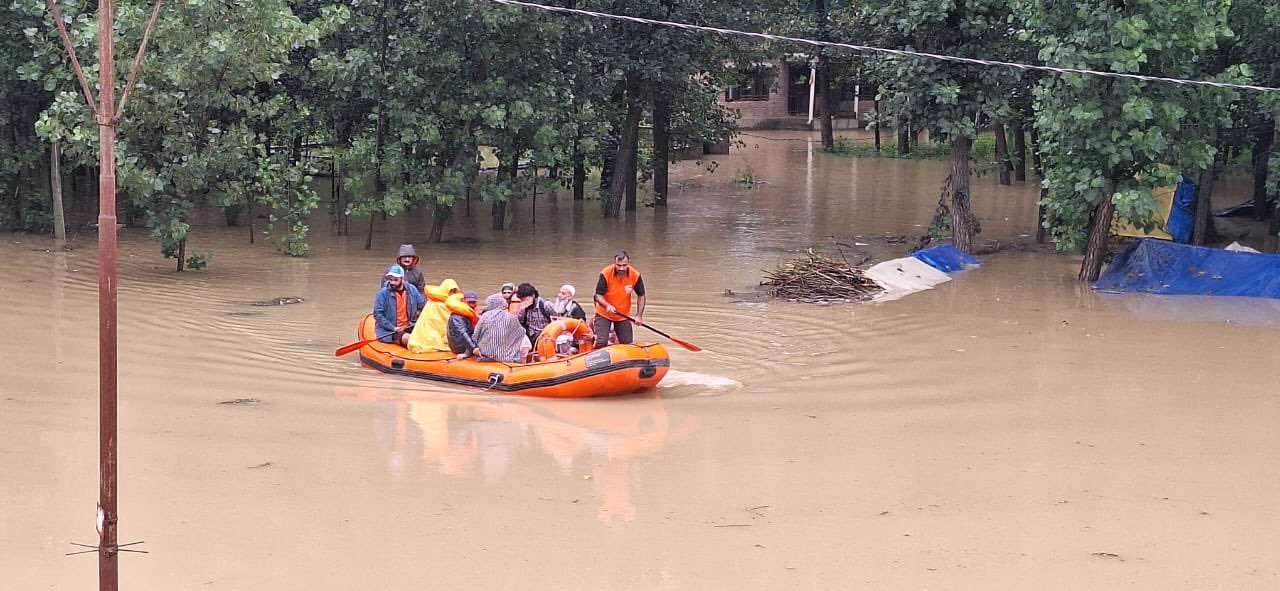
Srinagar, August 28, 2025 – As heavy monsoon rains continue to wreak havoc in Jammu and Kashmir, State Disaster Response Force (SDRF) teams have been swiftly deployed across various flood-affected areas of the Kashmir Valley to rescue individuals stranded in rising floodwaters. The operations, coordinated with the National Disaster Response Force (NDRF), Indian Army, and local administration, have already evacuated thousands from low-lying regions, including parts of Srinagar and Anantnag districts, where residential and commercial areas have been inundated.
The intensified rescue efforts follow torrential downpours that have caused the Jhelum River to swell, flooding key localities and reviving fears of the devastating 2014 floods. Officials report that while water levels are beginning to recede in some southern areas due to improving weather, vigilance remains high as the situation in central Kashmir, particularly Srinagar, continues to evolve. “SDRF and allied teams are on high alert, conducting round-the-clock rescues using boats and other equipment to reach those trapped in floodwaters,” stated a senior disaster management official.
Key Details of the Rescue Operations
Deployment Areas: SDRF teams are active in Srinagar (including Kursu, Rajbagh, Bemina, and Sekidafar), Anantnag (main town markets and district court complex), Kulgam, and other vulnerable spots along the Jhelum River and its tributaries.
Rescues Conducted: In Anantnag, SDRF personnel evacuated the district judge and staff from the submerged court complex using boats. Over 5,000 people have been shifted from low-lying areas across the broader Jammu and Kashmir region, with many operations focused on Kashmir Valley hotspots.
Coordination and Resources: Operations involve 24/7 control rooms for monitoring water levels, 49 mobile dewatering pumps in Srinagar, and collaboration with police, Army, NDRF, and district administrations. Essential supplies like food, water, and medical aid are being distributed at relief camps.
Challenges Faced: Continuous rainfall has hampered efforts, but helicopters and drones are on standby for aerial support. Landslides and debris have blocked some access routes, requiring earth-moving equipment for clearance.
Divisional Commissioner Kashmir, Anshul Garg, held an emergency meeting with department heads to review contingency plans, vulnerability mapping, and resource logistics. Instructions were issued to update a centralised dashboard for real-time tracking and to prioritise evacuation from flood-prone zones. “Our teams are committed to ensuring no one is left behind in these floodwaters,” Garg emphasised during the briefing.
Broader Impact of the Floods in Kashmir
The current crisis is part of a larger weather emergency affecting Jammu and Kashmir, with Jammu recording a record 380 mm of rainfall in 24 hours—the highest since 1910. Flash floods have damaged infrastructure, including bridges like the historic Madhopur on the Jammu-Pathankot highway, and disrupted essential services such as electricity, water supply, and internet. Schools and colleges remain closed, and non-essential movement has been advised against.
In addition to Kashmir, the floods have spilled over into adjacent areas, with evacuations reported in Samba, Akhnoor, and Pargwal. Lieutenant Governor Manoj Sinha highlighted the coordinated response, noting that the Army, NDRF, and SDRF are working non-stop. Union Minister Jitendra Singh confirmed that Prime Minister Narendra Modi is closely monitoring the situation and has assured full central assistance.
Earlier incidents, such as the August 14 cloudburst in Kishtwar district that killed at least 67 and left 200 missing, underscore the region’s vulnerability to such events, particularly during the ongoing Machail Mata Yatra pilgrimage. Rescue operations there also relied heavily on SDRF and NDRF teams.
Public Advisory and Next Steps
- Residents in low-lying areas are urged to move to higher ground or relief camps immediately.
- Helpline numbers for assistance: District-specific lines via the Jammu and Kashmir Disaster Management Authority (JKDMA) or national toll-free 1078.
- For updates, check official portals or apps from the India Meteorological Department (IMD), which forecasts moderate rains persisting in parts of Kashmir.
- Authorities appeal for public cooperation to avoid panic and facilitate smooth evacuations.
These SDRF-led rescues highlight the robust disaster response framework in place, aimed at minimising loss of life and property. As restoration efforts ramp up, the focus remains on safety and swift recovery for affected communities.