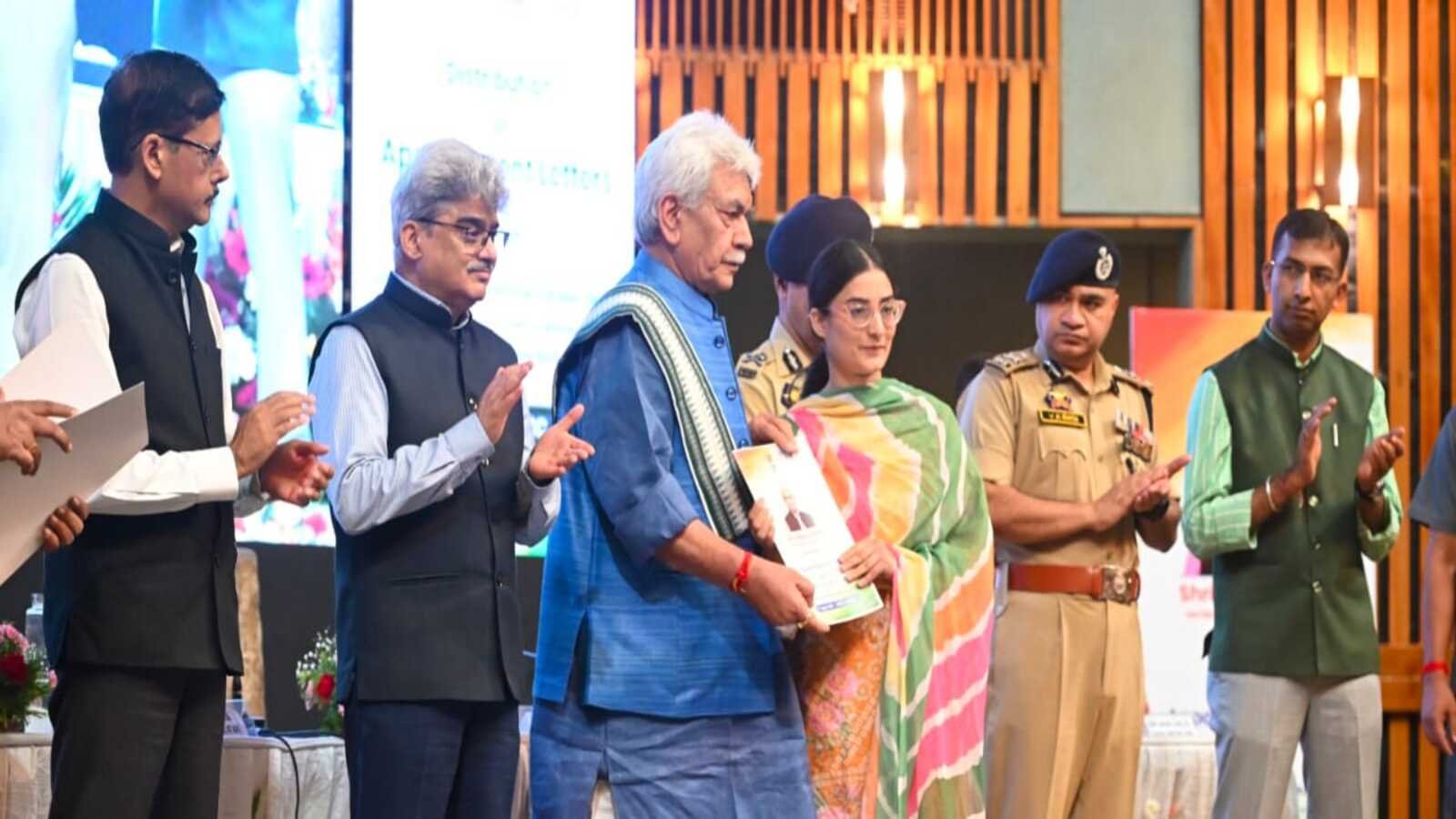
Srinagar, August 5,2026- In a significant step towards providing long-awaited relief to families affected by terrorism, Lieutenant Governor Manoj Sinha on Tuesday handed over appointment letters to 37 Next of Kins (NoKs) of civilians who lost their lives in terror attacks across Jammu & Kashmir. The event, held in Srinagar on the seventh anniversary of the abrogation of Article 370, was described by the Lieutenant Governor as more than a distribution of government jobs—it was a symbol of justice, remembrance, and the nation’s commitment to families who endured decades of suffering.
The ceremony highlighted the administration’s efforts to address the grievances of terror victims’ families while underscoring the broader changes witnessed in Jammu & Kashmir since the constitutional changes of August 5, 2019. Alongside the appointment letters issued to terror victims’ families, 32 additional beneficiaries also received appointments under the Compassionate Appointment Rules (SRO-43) and the Rehabilitation Assistance Scheme (RAS).
Appointment Letters Symbolise Recognition and Justice
Addressing the gathering, Lieutenant Governor Manoj Sinha paid tribute to civilians who lost their lives to terrorism over the past several decades and acknowledged the hardships faced by their families.
He said the appointment letters represented much more than employment opportunities. According to him, they symbolise dignity, recognition, social justice, and the nation’s resolve that victims of terrorism and their families will not be forgotten.
The Lieutenant Governor observed that for many years, families who had suffered because of terrorism remained largely unheard despite losing their loved ones. Many of these families lived through prolonged economic hardship while awaiting institutional support.
He stated that no financial assistance or government employment could replace the loss of a family member. However, he said the appointments demonstrate the government’s commitment to standing with affected families and helping them rebuild their lives with dignity.
Seven Years After Article 370
The event coincided with the seventh anniversary of the abrogation of Article 370, which reorganised the constitutional relationship between Jammu & Kashmir and the Union of India.
Speaking on the occasion, the Lieutenant Governor described 5 August 2019 as a turning point that initiated a new phase of governance, equal rights, and development for the Union Territory.
He said the constitutional changes removed discriminatory provisions, strengthened the principle of equal rights under the Constitution of India, and created opportunities for communities that had previously remained outside the full ambit of constitutional protections.
According to the Lieutenant Governor, the years following the abrogation have witnessed improvements in governance, public services, infrastructure, investment, education, and law enforcement.
Focus on Security and Counter-Terrorism
The Lieutenant Governor reiterated the administration’s commitment to dismantling the terror ecosystem operating in Jammu & Kashmir.
He said security agencies have significantly weakened terrorist networks over the past several years while improving the overall law and order situation across the Union Territory.
He asserted that terrorism had inflicted deep social and economic wounds by targeting innocent civilians, spreading fear, and disrupting normal life. The administration, he said, remains committed to bringing perpetrators and their supporters to justice.
He also issued a strong message that attempts by terrorist organisations and cross-border handlers to destabilise peace would not succeed.
According to him, the government remains determined to ensure that every citizen of Jammu & Kashmir can live in an atmosphere of peace, equality, security, and opportunity.
Justice for Terror Victims
A key focus of the programme was the administration’s renewed emphasis on addressing long-pending cases involving families of terror victims.
The Lieutenant Governor noted that several appointment cases remained unresolved for decades despite repeated appeals by affected families.
He said those pending cases are now being processed with urgency and sensitivity.
Describing justice for terror victims as a national responsibility, he said no genuine grievance should remain ignored and no victim’s family should feel abandoned.
According to him, the government aims to make assistance more timely, transparent, humane, and responsive while ensuring that victims receive institutional support without unnecessary delays.
A Story of Wali Mohammad Wani
During his address, the Lieutenant Governor referred to the family of Wali Mohammad Wani from Shopian, who was killed by terrorists on 16 July 1993.
He said that after more than three decades, the family has finally received institutional recognition and support through the appointment process.
The Lieutenant Governor described the development as symbolic of the government’s broader effort to reach families whose sacrifices had remained largely unacknowledged for many years.
He remarked that such initiatives reflect an attempt to restore dignity and reinforce the connection between affected communities and the national mainstream.
Equal Rights and Inclusive Development
The Lieutenant Governor also spoke extensively about governance reforms introduced after 2019.
According to him, communities that had previously faced legal and constitutional limitations now enjoy equal rights guaranteed under the Constitution of India.
He highlighted benefits extended to several sections of society, including tribal communities, displaced persons, refugees from Pakistan-occupied Kashmir (PoK), Chhamb refugees, and other historically disadvantaged groups.
He said these reforms have enabled broader participation in democratic institutions while expanding access to welfare schemes, property rights, education, and public services.
The administration views these measures as central to creating an inclusive framework for long-term development in Jammu & Kashmir.
Infrastructure and Economic Growth
Highlighting development initiatives undertaken over the past seven years, the Lieutenant Governor said Jammu & Kashmir has witnessed unprecedented improvements in physical infrastructure.
Major road projects, highways, bridges, railway connectivity, airports, healthcare institutions, educational facilities, and digital infrastructure have strengthened connectivity across the region.
He also referred to the completion of railway connectivity linking the Kashmir Valley with the national railway network, describing it as a historic milestone in improving mobility, trade, and tourism.
According to the Lieutenant Governor, the Union Territory has also experienced substantial industrial growth.
He stated that investment worth ₹5,824 crore was recorded during the financial year 2025–26, describing it as significantly higher than the average investment witnessed before 2021.
Government initiatives promoting industrial development, tourism, information technology, manufacturing, and entrepreneurship are expected to further strengthen the regional economy.
Employment and Youth Empowerment
Employment generation remains one of the administration’s major priorities.
The Lieutenant Governor said new investments, industrial policies, infrastructure projects, and educational reforms are creating greater opportunities for young people across Jammu & Kashmir.
He noted that universities, research institutions, incubation centres, and skill development programmes are preparing students for competitive careers both within and outside the region.
According to him, the future of Jammu & Kashmir will be shaped by its youth, entrepreneurs, teachers, workers, farmers, women, and professionals committed to peace and development.
He stressed that empowering young people through education and employment serves as an effective response to extremism by offering constructive alternatives and long-term opportunities.
Expanding Connectivity and Public Services
The administration also highlighted improvements in transport and public infrastructure.
Expansion work at Srinagar Airport and Jammu Airport, improved road connectivity, railway projects, and enhanced digital services are expected to further integrate Jammu & Kashmir with the rest of the country.
The Lieutenant Governor said the Government of India is also working to increase hydroelectric power generation in the Union Territory, with plans aimed at significantly expanding capacity over the coming years.
These projects, he noted, are intended to support economic growth while improving the quality of life for residents.
Message Against Terrorism
Throughout his address, the Lieutenant Governor maintained that terrorism cannot defeat a determined nation.
He said the government would continue pursuing individuals involved in terrorism while ensuring that innocent citizens receive justice and protection.
He warned that those attempting to disrupt peace or undermine public institutions would face strict legal consequences.
According to him, lasting peace depends upon strong institutions, equal opportunities, accountable governance, and public confidence in the rule of law.
Looking Ahead
The appointment ceremony reflected both a humanitarian initiative and a broader message regarding Jammu & Kashmir’s ongoing transformation.
For families who lost loved ones to terrorism, the appointment letters represented official recognition after years—sometimes decades—of waiting.
For the administration, the programme formed part of a larger effort to combine justice, security, development, and inclusive governance as Jammu & Kashmir continues its post-2019 development trajectory.
Seven years after the abrogation of Article 370, the Union Territory continues to witness changes in governance, infrastructure, investment, public services, and economic activity. While security challenges remain, the administration maintains that sustained development, institutional reforms, and support for affected families will remain central to its vision for Jammu & Kashmir’s future.